What Time Was It 15 Hours Ago? Here’s How to Find Out
Trying to piece together a timeline and need to know exactly what time it was 15 hours back? Maybe you’re checking an alibi, tracking a shift change, or just settling a random argument. The math is simpler than it looks. Here’s a clear way to work it out, plus a few details most people overlook.
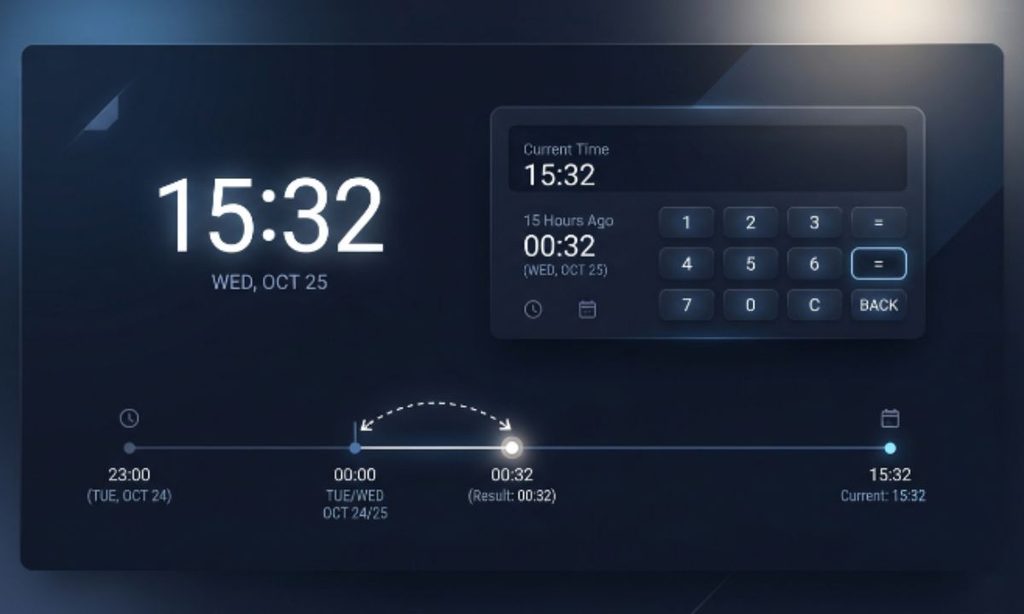
The core idea is simple: take the current time and subtract 15 hours from it. That’s the whole formula.
Current time − 15 hours = the time 15 hours ago
The tricky part isn’t the subtraction itself; it’s keeping track of the date when the hours roll backward past midnight. We’ll cover that in detail below, but first, let’s break 15 hours down into units you can work with more easily.
What Is 15 Hours in Other Units?
Sometimes it helps to see 15 hours expressed differently, especially if you’re doing a calculation that mixes hours with minutes or seconds.
15 Hours in Minutes
15 hours × 60 minutes = 900 minutes
15 Hours in Seconds
900 minutes × 60 seconds = 54,000 seconds
15 Hours as a Fraction of a Day
A full day has 24 hours, so 15 hours works out to:
15 ÷ 24 = 0.625 of a day
That’s a little over half a day, roughly five-eighths of it. Useful context if you’re comparing durations or trying to visualize how much of a 24-hour cycle has passed.
How to Calculate 15 Hours Ago Manually
You don’t need a calculator app to figure this out. Here’s a step-by-step method that works with any starting time.
Write down the current time in 24-hour format. For example, 4:00 PM becomes 16:00.
Subtract 15 from the hour. 16 − 15 = 1. That gives you 1:00, or 1:00 AM.
Check if the hour went negative. If subtracting 15 from your current hour drops below 0, add 24 to the result and move the date back by one day.
Let’s walk through an example where the hour goes negative:
Current time: 9:00 AM, which is 09:00 in 24-hour format.
Subtract 15: 09 − 15 = −6.
Since the result is negative, add 24: −6 + 24 = 18.
That gives you 18:00, or 6:00 PM, on the previous calendar day.
So if it’s 9:00 AM on a Tuesday, 15 hours ago was 6:00 PM on Monday.
This “borrow a day” step is the part people usually get wrong, so it’s worth double-checking any time your subtraction goes below zero.
How an Online Time Calculator Works
If manual subtraction isn’t your thing, an online time calculator handles it instantly. Most of these tools follow the same basic flow.
Enter the Time Duration
You start by entering the number of hours (in this case, 15), along with any additional minutes if needed.
Select “Ago”
Most calculators let you choose a direction, either “from now” for a future time or “ago” for a past time. Selecting “ago” tells the tool to subtract instead of add.
Review the Date and Time
Once you calculate, the tool returns a full date and time, not just a clock reading. This matters because, as shown above, subtracting hours can shift you into the previous day.
A good calculator will always show both the time and the date together, since a time alone can be ambiguous once you cross midnight.
Does 15 Hours Ago Mean Yesterday?
It depends entirely on what time it is right now. There’s no fixed answer.
If it’s currently anywhere from midnight to 2:59 PM, subtracting 15 hours pushes you back into the previous calendar day.
If it’s currently 3:00 PM or later, subtracting 15 hours keeps you within today.
Here’s a quick reference table to make this clearer:
Current Time
15 Hours Ago
Same Day or Previous Day?
1:00 AM
10:00 AM (prior day)
Previous day
8:00 AM
5:00 PM (prior day)
Previous day
2:00 PM
11:00 PM (prior day)
Previous day
3:00 PM
12:00 AM (midnight, today)
Same day (right at the boundary)
6:00 PM
3:00 AM (today)
Same day
11:00 PM
8:00 AM (today)
Same day
The tipping point is 3:00 PM. Anything before that, and 15 hours ago lands you on the previous day. Anything at or after that, and you stay within today.
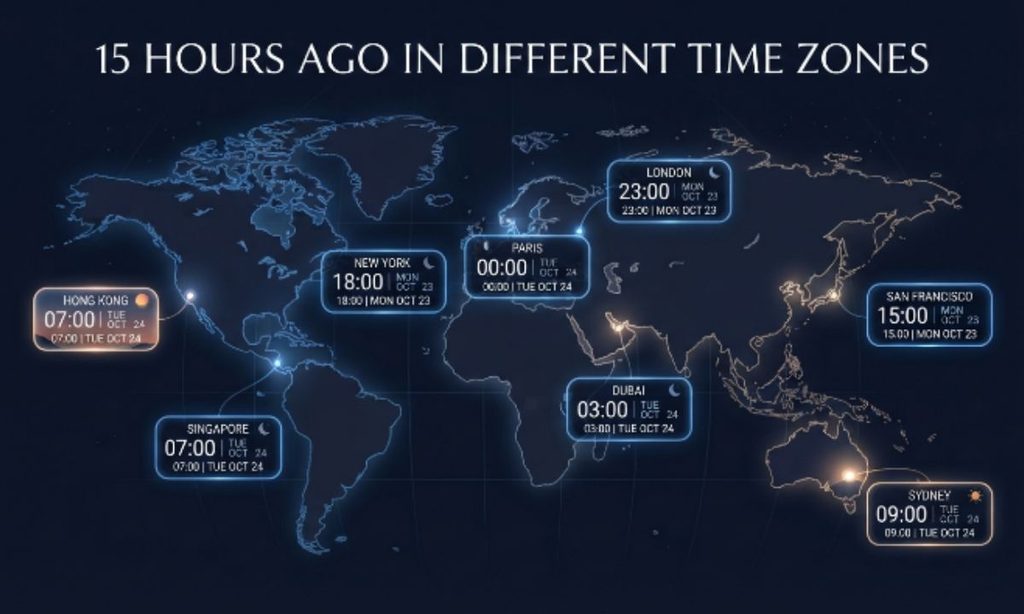
15 Hours Ago in Different Time Zones
Time zones add another layer that’s easy to forget. “15 hours ago” only makes sense relative to a specific time zone, because the same 15-hour subtraction produces a different result depending on where you’re standing.
If you’re comparing timestamps across regions, for example, checking when a message was sent from someone in another country, you need to know which time zone the original timestamp used before you subtract anything.
A few practical tips:
If you’re working with UTC (Coordinated Universal Time), convert to your local time zone first, or keep everything in UTC for consistency.
If you’re comparing two people’s schedules across time zones, calculate each person’s local “15 hours ago” separately rather than assuming they match.
Around daylight saving time transitions, be extra careful. Clocks shifting forward or backward by an hour can throw off a manual calculation if you’re not accounting for it.
15 Hours Ago: Timeline and Date Changes
It helps to visualize this as a simple timeline. Picture 24 hours split into two zones:
Zone A (12:00 AM to 2:59 PM): Subtracting 15 hours from any point here lands you the previous day.
Zone B (3:00 PM to 11:59 PM): Subtracting 15 hours from any point here keeps you on the same day.
Once you know which zone your current time falls into, you immediately know whether you’re checking yesterday’s calendar or today’s.
This is especially useful for anyone piecing together a sequence of events, since getting the date wrong by one day is a common and easy mistake.
Related Time Calculations
Once you’ve got 15 hours ago figured out, a few related calculations often come up alongside it:
14 hours ago and 16 hours ago, useful for comparing nearby intervals.
15 hours from now, the mirror version of this calculation, using addition instead of subtraction.
12 hours ago and 24 hours ago, common reference points people check alongside odd-numbered hour gaps.
Converting 54,000 seconds, or 900 minutes, back into hours, useful if you’re working from a duration expressed in smaller units.
Calculating the current day of the year, week number, or days remaining in the year, handy for scheduling or planning purposes tied to a specific date.
Keeping these related calculations in mind saves you from having to start from scratch each time you need a nearby figure.
Frequently Asked Questions
What time was it 15 hours ago?
Subtract 15 from the current hour (in 24-hour format); if the result is negative, add 24 and move back one calendar day.
Is 15 hours ago yesterday or today?
It’s yesterday if the current time is before 3:00 PM and today if the current time is 3:00 PM or later.
How many minutes are in 15 hours?
15 hours equals 900 minutes.
How many seconds are in 15 hours?
15 hours equals 54,000 seconds.
Does “15 hours ago” change based on time zone?
Yes, since the calculation is based on local time, the same 15-hour subtraction gives a different result in each time zone.
Conclusion
Figuring out what time it was 15 hours ago just takes one subtraction: current time minus 15, with a quick check for whether the hour dips below zero and pulls you into the previous day. Once you know the 3:00 PM tipping point and keep time zones in mind, you can work this out in seconds, no calculator required, though one certainly doesn’t hurt if you’d rather skip the math.
I’m a passionate pet writer who loves sharing practical tips, trusted advice, and heartwarming stories about cats, dogs, and other beloved companions. Through PetCaffine.com, I help pet lovers better understand their furry friends with easy-to-read articles on pet care, nutrition, behavior, health, and everyday life.







1 thought on “What Time Was It 15 Hours Ago? Here’s How to Find Out”