What Time Was It 12 Hours Ago? A Simple Way to Find Out
You glance at a message timestamp, and it says “12 hours ago.” Was that this morning or last night? Your brain hesitates for a second, and that second is annoying. Here’s how to answer it in five seconds flat, every time.
The rule is simple: take the current time, subtract 12 hours, and keep the minutes exactly as they are.
If it’s 3:15 PM now, 12 hours ago was 3:15 AM.
If it’s 9:40 AM now, 12 hours ago was 9:40 PM the previous day.
If it’s 11:00 PM now, 12 hours ago was 11:00 AM the same day.
Notice the pattern: the minutes never change. Only two things move — the hour flips between AM and PM, and the date sometimes rolls back by one day. That’s really the whole trick. Everything else in this guide is just extra detail for the situations where people get tripped up.
Why 12 Hours Is the Easiest Interval to Calculate
Most“hours ago”questions require you to think about carrying digits, crossing midnight, or juggling a 24-hour clock. Twelve hours skips most of that work.
Since a standard clock face only has 12 numbers on it, subtracting 12 hours just means flipping AM to PM or PM to AM. You don’t need to touch the minutes at all.
Compare that to something like 7 hours ago, where you actually have to do subtraction and possibly borrow an hour. Twelve is the shortcut interval — which is exactly why so many people search for it, even though it’s one of the simplest calculations on the clock.
Step-by-Step: How to Calculate 12 Hours Ago Manually
The AM/PM Flip Method
This is the fastest method, and it works for almost anyone who grew up reading a 12-hour clock.
Look at the current time.
Keep the hour and minute numbers exactly as they are.
Flip AM to PM, or PM to AM.
If the current time is before noon, the date moves back one day.
That’s it. No arithmetic required.
Example: it’s 6:22 AM on a Tuesday. Flip AM to PM, keep 6:22, and move the date back one day. The answer is 6:22 PM on Monday.
The 24-Hour Clock Method
If you prefer working in 24-hour (military) time, this method is even more mechanical.
If the current hour is 12 or higher, subtract 12 from the hour number. The date stays the same.
If the current hour is below 12, add 12 to the hour number, and move the date back one day.
Example: it’s 15:40 (3:40 PM). Since 15 is 12 or higher, subtract 12: 15 − 12 = 3. The answer is 03:40 on the same date.
Example: It’s 05:10 (5:10 AM). Since 5 is below 12, add 12: 5 + 12 = 17. The answer is 17:10 (5:10 PM) the day before.
The Reverse-Check Method
Once you have an answer, check it by adding 12 hours back to it. You should land exactly on your starting time. If you don’t, you made an error somewhere in the flip.
Does the Date Change When You Go Back 12 Hours?
Yes, about half the time — and this is the part people actually get wrong.
Because 12 hours is exactly half of a 24-hour day, the date changes whenever your current time falls in the morning (midnight through 11:59 AM). If your current time is in the afternoon or evening (noon through 11:59 PM), the date stays the same.
Here’s a quick reference table so you never have to guess:
Current Time
12 Hours Ago
Date Change?
12:00 AM (midnight)
12:00 PM (noon)
Yes, previous day
3:00 AM
3:00 PM
Yes, previous day
8:00 AM
8:00 PM
Yes, previous day
11:59 AM
11:59 PM
Yes, previous day
12:00 PM (noon)
12:00 AM (midnight)
No, same day
4:00 PM
4:00 AM
No, same day
9:00 PM
9:00 AM
No, same day
11:59 PM
11:59 AM
No, same day
A useful memory trick: if the clock currently reads a morning time, you’re going back into “yesterday.” If it reads an afternoon or evening time, you’re staying in “today.”
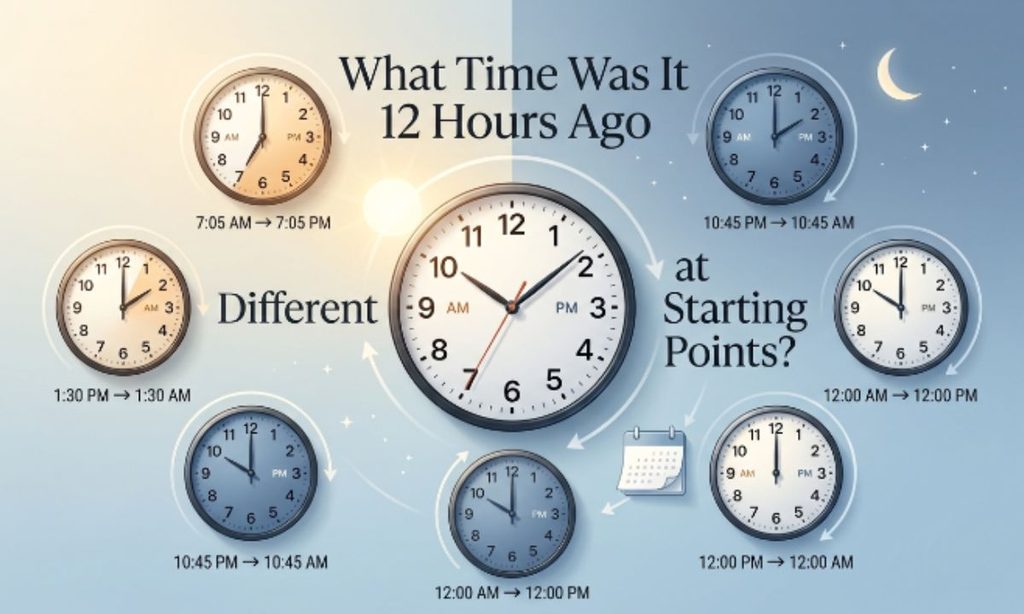
What Time Was It 12 Hours Ago at Different Starting Points?
Seeing a few worked examples side by side makes the pattern click faster than any explanation.
Starting at 7:05 AM → 12 hours ago was 7:05 PM the previous day.
Starting at 1:30 PM → 12 hours ago was 1:30 AM the same day.
Starting at 10:45 PM → 12 hours ago was 10:45 AM the same day.
Starting at 12:00 AM (midnight) → 12 hours ago was 12:00 PM (noon) the previous day.
Starting at 12:00 PM (noon) → 12 hours ago was 12:00 AM (midnight) the same day.
Noon and midnight trip people up the most, because “12” appears on both AM and PM sides of the clock. Just remember: midnight is the start of a new day, and noon is the middle of the current one.
Why Your Time Zone Matters
“12 hours ago” only means something once you fix a location. The same instant in time looks completely different depending on where you’re standing.
Say a colleague in Tokyo sends you a message and your app says it arrived “12 hours ago.” If you’re in New York, that message was sent at a time that, in Tokyo’s clock, is also 12 hours earlier than Tokyo’s current time — but the actual wall-clock hour you’d see on a Tokyo clock and a New York clock for that same moment are different because of the time zone offset itself, which is separate from the 12-hour gap you’re calculating.
In practice, this means:
Always confirm whether the timestamp you’re reading uses your local time zone or the sender’s time zone.
Apps and platforms often silently convert timestamps to the viewer’s local time, which is convenient but can hide the original time zone entirely.
If you’re scheduling something across regions, calculate 12 hours ago in UTC first, then convert to each local time zone. This avoids compounding errors.
A quick way to sanity-check cross-timezone math: convert both the reference time and your answer to UTC, do the subtraction there, then convert back.
For international teams, it’s worth agreeing on one shared reference, usually UTC, for anything time-sensitive, and letting each person’s calendar app handle the local display.
Does Daylight Saving Time Affect the Calculation?
Yes, but only in one specific scenario: when the 12-hour window you’re calculating happens to cross the exact moment a region springs forward or falls back.
For the vast majority of days, daylight saving time has zero effect on a “12 hours ago” calculation, since clocks only change twice a year. But if you’re calculating across a DST transition date:
Falling back (clocks move back one hour) adds an extra hour to the actual elapsed time, so a device or app might display “12 hours ago” when the true gap was 13 hours.
Springing forward (clocks move ahead one hour) removes an hour, so “12 hours ago” might actually reflect 11 elapsed hours.
If precision matters, for example in legal, financial, or shift-scheduling contexts, and your calculation falls near a DST changeover date, it’s worth double-checking against a time zone that doesn’t observe daylight saving, or working in UTC, which never shifts for DST.
Common Mistakes When Calculating 12 Hours Ago
Even a simple calculation goes wrong in predictable ways. Watch for these:
Forgetting to flip AM/PM. Keeping the same AM or PM label is the single most common error.
Losing track of the date. People often get the clock time right but forget the date rolled back.
Confusing noon and midnight. Both display as “12,” which reverses their usual AM/PM logic.
Trusting an app’s rounded label. A notification that says “12 hours ago” is frequently an approximation, not an exact timestamp. Many platforms round to the nearest hour or even display stale cached values.
Ignoring time zone differences. A timestamp that looks 12 hours old on your phone might reflect a different offset than the one the sender used.
Skipping the DST check. Rare, but costly, when it applies to scheduling or legal deadlines.
When an Exact Timestamp Matters More Than a Rough Estimate
Not every “12 hours ago” question is casual. Here are situations where the exact figure genuinely matters:
Work logs and shift records, where hours worked need to be accurate to the minute for payroll.
Delivery and shipping notifications, where “12 hours ago” affects whether a package is on schedule.
Missed calls and messages, where knowing the precise time helps you judge urgency.
Legal or compliance deadlines, where a miscalculated hour can matter.
International meetings, where a 12-hour gap in one time zone might not align cleanly with another.
Server logs and technical debugging, where exact timestamps help trace the sequence of events.
For anything with real consequences, don’t rely on an app’s rounded label. Check the raw timestamp, confirm the time zone, and do the subtraction manually or with a dedicated calculator.
A Quick Formula You Can Reuse
For any “X hours ago” question, not just 12, the underlying formula stays the same:
Past time = Current time − Elapsed hours
And going the other direction:
Future time = Current time + Elapsed hours
Once you’re comfortable with the 12-hour version, the same AM/PM flip logic extends naturally. For 24 hours ago, the time stays identical, and only the date moves back one day. For 6 hours ago, you’re doing a partial flip that usually stays within the same half of the day. Twelve hours just happens to be the cleanest case to learn the pattern on.
Frequently Asked Questions
Is 12 hours ago the same clock time as now?
Yes, the hour and minute numbers stay the same, but AM/PM flips, and the date may shift back one day.
What time was it 12 hours ago if it’s 3 AM now?
It was 3 PM the previous day.
Does 12 hours ago mean yesterday?
Only if the current time is before noon; otherwise it’s still today.
Why does an app say “12 hours ago” when the exact time seems different?
Many apps round timestamps to the nearest hour or use cached data, so the label is often approximate rather than exact.
Does daylight saving time change the answer?
Only if the 12-hour window crosses a DST changeover date; otherwise it has no effect.
Conclusion
Figuring out what time it was 12 hours ago really comes down to one move: flip AM to PM (or the reverse), keep the minutes untouched, and check whether the date needs to roll back a day. That covers the vast majority of cases you’ll run into day to day.
The only times it gets more complicated are when time zones or daylight saving changes are involved, and even then, converting to UTC first will keep you accurate. Once you’ve run through the AM/PM flip a couple of times, you won’t need a calculator at all.
I’m a passionate pet writer who loves sharing practical tips, trusted advice, and heartwarming stories about cats, dogs, and other beloved companions. Through PetCaffine.com, I help pet lovers better understand their furry friends with easy-to-read articles on pet care, nutrition, behavior, health, and everyday life.



2 thoughts on “What Time Was It 12 Hours Ago? A Simple Way to Find Out”