OD Meaning: What Does “OD” Stand for in Different Contexts?
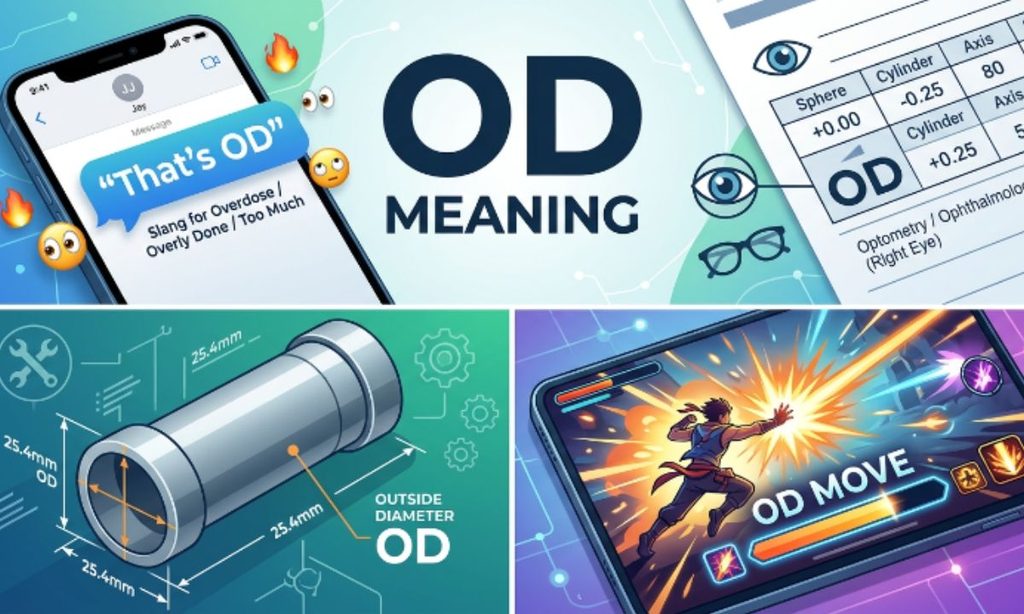
You’ve seen “OD” in a text from a friend. You’ve seen it on an eye doctor’s prescription pad. And You’ve maybe even seen it in a Street Fighter 6 combo video. Here’s the thing: it means something different every single time.
There’s no single answer to “what does OD mean,” and that’s exactly why people get confused. OD is one of those short, punchy abbreviations that different industries and communities picked up and bent to their own purposes over the decades.
The short answer: OD usually means one of these things, depending on where you see it.
Overdoing it or too much (slang, texting, social media)
Overdose (medical, drug-related conversations)
Right eye, from the Latin oculus dexter (eye prescriptions)
Doctor of Optometry (a professional credential)
Once daily (medication instructions, though this one is genuinely ambiguous)
Why so many meanings packed into two letters? Mostly coincidence. OD is short, easy to say, and easy to type. Different fields independently landed on it as shorthand for very different concepts, and none of them coordinated with each other. So the abbreviation survived in medicine, in eye care, in the military, in banking, and in internet slang, all at once.
That means context is everything. Read the sentence around OD, and the actual meaning usually becomes obvious. Read it in isolation, and you’re stuck guessing.
OD Meaning in Slang and Texting
If you saw OD in a text, a TikTok comment, or an Instagram caption, it almost certainly does not mean overdose. In casual conversation, OD is shorthand for excess or intensity.
Common ways people use it:
“You’re OD” → you’re doing too much, being dramatic, or overreacting
“That’s OD” → that’s extreme, excessive, or over the top
“This food is OD good” → this food is extremely good
“I’m OD tired” → I’m very tired
“That outfit is OD” → that outfit is flashy or attention-grabbing
The tone can go either way. Sometimes OD is a light criticism (you’re overreacting). Sometimes it’s a compliment dressed up as an insult (that’s insanely good). And sometimes it’s just a stand-in for “very” or “extremely,” with no judgment attached at all.
This usage shows up a lot in Gen Z internet language, and it’s especially common in New York and East Coast slang, where it likely has some of its roots. That said, be cautious about any claim that pins this down to one exact origin or one exact generation. The internet moves faster than anyone can document it, and plenty of “Gen Z slang” claims are more assumption than research.
One important note: if the conversation involves drugs, medication, or someone’s physical condition, don’t assume OD is harmless slang. Context still rules.
OD Meaning as Overdose
This is the meaning most people learn first, and it’s the one that carries real weight.
As a noun, OD means an overdose, usually involving drugs. As a verb, “to OD” means to take a dangerously large amount of a substance, sometimes fatally. You’ll see the past tense written as “OD’d” or “ODed” and the continuous form as “OD’ing.”
Noun: “She survived an OD last year.”
Verb: “He OD’d on painkillers.”
Figurative use: “I OD’d on Netflix this weekend” (a non-drug, exaggerated use meaning “consumed too much of”)
That figurative stretch is where things get tricky. Because OD can mean either a life-threatening emergency or a joke about binge-watching, tone and setting matter enormously. If someone is talking about drugs, medication, or a friend’s symptoms, treat OD as serious until proven otherwise.
If you or someone you know is in an overdose emergency, call emergency services immediately. Common warning signs include slowed or stopped breathing, blue lips or fingertips, unresponsiveness, and vomiting while unconscious. Don’t wait to see if symptoms pass.
OD Meaning on an Eye Prescription
Step into an optometrist’s office, and “OD” suddenly means something completely different: right eye.
OD comes from the Latin phrase oculus dexter, which literally translates to “right eye.” You’ll see it written on:
Glasses prescriptions
Contact lens prescriptions
Eye drop and ointment instructions
Post-surgery eye care notes
A typical prescription might read OD -2.00, OS -1.50. That means the right eye needs a -2.00 correction, and the left eye needs a -1.50 correction.
OD vs. OS vs. OU
These three abbreviations travel together, and mixing them up is an easy mistake to make.
Abbreviation
Latin term
Meaning
OD
Oculus Dexter
Right eye
OS
Oculus Sinister
Left eye
OU
Oculus Uterque
Both eyes
A simple way to keep them straight: OD and “right” both come later in the alphabet order most people learn (D comes after S), while OS starts with the same sound as “sinister,” which is the Latin root for left. If that doesn’t stick, just remember D for “dexter,” and dexter is Latin for right-handed.
If an eye-care instruction ever looks unclear or the abbreviation doesn’t match what you expected, ask your pharmacist or eye doctor to confirm. It’s a five-second question that prevents putting medication in the wrong eye.
OD Meaning After an Eye Doctor’s Name
You might also see “OD” tacked onto a name, like “Dr. Sarah Chen, OD.” Here, it stands for Doctor of Optometry, a professional credential.
An optometrist with an OD degree can:
Perform full eye exams
Diagnose and manage many eye conditions
Prescribe glasses and contact lenses
Detect early signs of diseases like glaucoma or diabetes-related eye damage
Provide low-vision care
It’s worth knowing how this differs from other eye-related credentials:
OD (Doctor of Optometry): focuses on vision correction, routine eye health, and diagnosis
MD (ophthalmologist): a medical doctor who can also perform eye surgery
DO (Doctor of Osteopathic Medicine): a broader medical degree, not eye-specific
So OD can mean a body part (right eye) or a person’s professional title (Doctor of Optometry), depending on where it sits in the sentence. If it follows a name, it’s the credential. If it’s paired with a lens prescription value, it’s the eye.
OD Meaning in Medication Instructions
Here’s where things get genuinely confusing, even for careful readers: some medical shorthand uses OD to mean once daily or every day.
This creates overlap with two other meanings you’ve already seen:
OD as the right eye
OD as overdose
In a prescription that reads “OD” next to a medication name, it might mean “take once a day.” But if that same abbreviation shows up on an eye medication, it almost certainly means “apply to the right eye.” And in a clinical or emergency note, it could reference overdose entirely.
Never guess. If a prescription or medical instruction has an ambiguous OD, ask the prescribing doctor or your pharmacist to clarify before taking or administering anything. This isn’t a case where “it’s probably fine” is good enough. Medication errors from misread abbreviations are a documented and preventable problem, and confirming takes less time than a phone hold.
OD Meaning in Gaming
Gamers use OD to describe something that feels unfairly strong or intense.
“That weapon is OD” → that weapon is overpowered
“That combo was OD” → that combo was excessive or nearly impossible to counter
“Stop OD’ing” → stop taking unnecessary risks or overplaying your hand
This usage overlaps heavily with general slang (excess, intensity) but gets applied specifically to game balance and skill displays.
There’s also a game-specific technical meaning worth knowing: in Street Fighter 6, OD refers to an Overdrive Move, a stronger version of a special move that costs meters to perform, similar to what older fighting games called an “EX move.”
This is a defined mechanic in the game’s system, not slang. So “OD” in a Street Fighter 6 guide means something precise and rules-based, while “OD” in a general gaming chat is just casual exaggeration.
OD Meaning in Optics and Science
In physics and lab settings, OD stands for optical density, a measurement of how much a material blocks light from passing through it.
The basic idea: shine light through a filter or sample, and optical density tells you how much of that light gets absorbed or blocked rather than transmitted. The higher the OD value, the less light gets through.
The formula looks like this:
OD = -log₁₀(T)
Where T is the transmission fraction (the percentage of light that makes it through, expressed as a decimal). Because the formula uses a logarithm, OD values scale non-linearly. A small increase in OD can represent a big drop in light transmission.
You’ll run into optical density in:
Laboratory absorbance testing
Camera and telescope filters
Laser safety eyewear ratings
Welding and industrial eye protection
One technical note: some scientific bodies prefer the term “absorbance” over “optical density” for precision, since the two aren’t always perfectly interchangeable depending on whether scattering is involved. If you’re doing formal lab work, it’s worth knowing which term your field actually expects.
In manufacturing, plumbing, and mechanical specs, OD simply means outside diameter (sometimes “outside dimension”). It describes the measurement across the outer edge of a round object, like a pipe, tube, rod, or fitting.
This matters because pipes and tubes are also measured by ID, or inside diameter, the measurement of the hollow space inside. Mixing up OD and ID when ordering parts can mean a fitting simply won’t work, so double-checking which measurement a spec sheet is using is a smart habit.
Example: A pipe listed as “2 inch OD” measures 2 inches across its outer wall, not its interior opening.
Other Meanings of OD
OD shows up in plenty of other corners too, usually as workplace or industry-specific shorthand:
On demand – available whenever requested, common in business and streaming contexts
Overdraft / overdrawn – banking terms for spending more than an account holds
Overdue – something past its due date
Officer of the Day – a military duty assignment
Olive drab – a shade of green used in military uniforms and equipment
Ordnance Department – a military supply and equipment division
Overdrive – a mechanical gear setting, or a brand name in various industries
One Direction – the band, occasionally shortened this way in fan communities
None of these are common enough to cause confusion outside their specific fields, but they’re worth knowing if you run into “OD” in an unexpected place.
Frequently Asked Questions
What does OD mean in a text message?
It usually means “overdoing it,” “too much,” or “extremely,” depending on the sentence.
Which eye is OD in a prescription?
OD stands for oculus dexter, meaning the right eye.
Does OD mean overdose or once daily on a prescription?
It can mean either, so always confirm unclear medication abbreviations with your pharmacist or doctor.
What does OD mean in gaming?
It typically means “overpowered” or excessively strong, and in Street Fighter 6 it also refers to a specific Overdrive Move mechanic.
What is optical density (OD) in science?
It’s a measurement of how much a material reduces the amount of light passing through it, calculated as OD = -log₁₀(T).
Final Thoughts
OD is proof that a two-letter abbreviation can carry an entire dictionary’s worth of meaning, and the only real key to decoding it is context. Whether you’re reading a text from a friend, a prescription from your doctor, a spec sheet for plumbing parts, or a gaming forum, the words surrounding “OD” will tell you which version you’re dealing with.
When the stakes are low, like slang in a group chat, a wrong guess costs you nothing. When the stakes are higher, like a medication instruction or a prescription note, it’s always worth pausing to ask rather than assume.
I’m a passionate pet writer who loves sharing practical tips, trusted advice, and heartwarming stories about cats, dogs, and other beloved companions. Through PetCaffine.com, I help pet lovers better understand their furry friends with easy-to-read articles on pet care, nutrition, behavior, health, and everyday life.








3 thoughts on “OD Meaning: What Does “OD” Stand for in Different Contexts?”