You get a text that just says “YK” and nothing else. Is your friend agreeing with you, or calling you a liar? Two letters, two totally different reactions, and the wrong guess can make a conversation awkward fast. Here’s how to actually tell the difference.
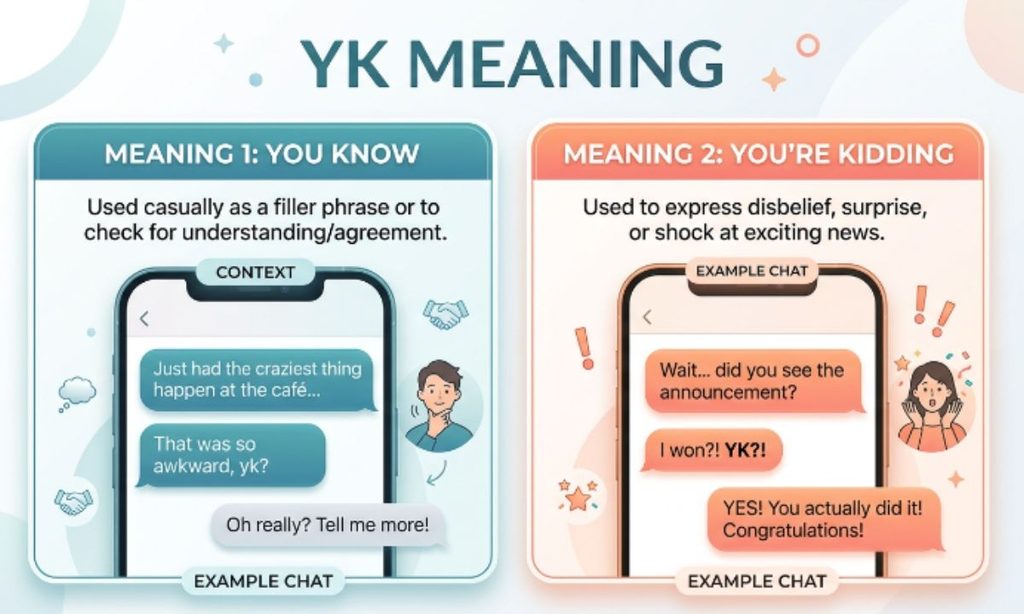
YK is one of those abbreviations that flips meaning depending on where it lands in a sentence. There isn’t one fixed definition, and that’s exactly why people search for it. The two dominant meanings:
“You know” – used to invite agreement, signal shared understanding, or add a conversational tone to a message
“You’re kidding” – used to react to surprising or unbelievable news, usually expressing disbelief
There’s also a much rarer third meaning, “Young King,” which shows up occasionally in music and pop-culture contexts, most notably tied to the artist YK Osiris.
Is YK an acronym, an abbreviation, or slang? Technically, it’s an abbreviation, since it’s not pronounced as a word the way a true acronym would be (like “NASA”). But functionally, everyone treats it as slang, best kept to casual texting and social media rather than anything formal.
So how do you know which meaning applies? Look at where YK sits in the sentence and what comes before or after it. That single habit solves almost every case of confusion.
YK Meaning in Text Messages
In everyday texting, “you know” is the meaning you’ll run into most often. It works almost like a verbal tic that made the jump from spoken English into typed conversation.
People use YK to:
Add emphasis to a statement
Invite the other person to agree
Soften something emotional or vulnerable
Reference a shared experience without spelling it out
Avoid repeating information the listener already has
Examples:
“That movie was so chaotic, yk?”
“I’ve just been off lately, you know.”
“It’s been a rough week, yk…”
“I didn’t like the vibe there, yk what I mean?”
Notice how YK often shows up right before “what I mean,” working as a shorthand nudge that says “you get it, right?” That’s the core function: it’s less about information and more about connection.
What Does “YK?” Mean?
Add a question mark, and the ambiguity gets sharper. “YK?” on its own could mean two very different things.
“You know?” – checking whether the listener understands or relates
“You kidding?” – checking whether the previous statement was actually true
The only way to tell them apart is to read what comes right before it.
Message
Likely meaning
“I finally quit my job. YK?”
Ambiguous alone, but likely “you know?” seeking a reaction
“I won $10,000 on a scratch ticket. YK?”
Almost certainly “you kidding?” expressing disbelief
“It’s exhausting dealing with that, yk?”
“You know?” inviting agreement
“She said she’s moving to Paris. YK??”
“You kidding??” reacting to shocking news
A good rule of thumb: if the sentence right before YK describes something surprising, unlikely, or hard to believe, YK probably means “you’re kidding.” If the sentence describes a feeling, opinion, or shared situation, YK probably means “you know.”
YK Meaning as “You Know”
This is the broader, more flexible of the two main meanings, and it shows up in a few distinct positions within a sentence.
At the start of a sentence: “YK, I really thought this would go differently.”
In the middle of a sentence: “I just, yk, needed a minute to think.”
At the end of a sentence: “That whole situation was weird, yk.”
As a standalone question: “YK?”
Each position does slightly different work. At the start, it softens what’s coming. In the middle, it acts like a filler pause, the same way people say “um” or “like” out loud. At the end, it invites the listener to agree or relate.
Emotionally, “you know” YK can carry:
Agreement-seeking (“Right, yk?”)
Frustration (“This is ridiculous, yk.”)
Sadness or vulnerability (“I’ve just been struggling, yk…”)
Excitement (“This is going to be so good, yk!!”)
The emoji or punctuation attached to the message usually tells you which emotional register is in play, more than the letters YK themselves.
YK Meaning as “You’re Kidding”
This version of YK is a reaction, not a filler. It shows up when someone shares something hard to believe, and the other person responds with surprise or skepticism.
Examples:
Person A: “I just found out I got the promotion!” Person B: “YK?! That’s amazing!”
Person A: “My cat somehow got locked in the neighbor’s garage for six hours.” B: “YK, that’s wild.”
Person A: “I saw a shooting star land in my backyard last night.” Person B: “YK, there’s no way that actually happened.”
This meaning overlaps with a small family of related abbreviations:
AYK – “Are you kidding”
AYKM – “Are you kidding me”
JK – “just kidding” (a reply, not a question)
NK – “no kidding,” used to confirm something is actually true
If someone responds to your YK with “no, for real” or “I’m serious,” that confirms YK was read as “you’re kidding” in that exchange.
YK Meaning on Social Media
YK Meaning on Social Media
Across platforms, “you know” is still the dominant sense, but each app gives it a slightly different flavor.
Instagram – shows up in captions and comments to create a relaxed, lifestyle tone: “Living my best life rn, yk?”
TikTok – common in captions and replies, often making a video feel more personal or relatable.
Snapchat – used in quick messages alongside casual updates about what someone’s doing
WhatsApp – appears in private chats, usually in the “you know” sense, often paired with a joke or shared memory.
The tone shifts slightly by format. Captions tend to be more expressive and performative. Direct messages read as more conversational. Comments often function as quick agreement or relatability markers.
How to Respond to YK
Getting the reply right depends entirely on figuring out which YK you’re dealing with first.
If YK means “you know”:
“Totally.”
“I know exactly what you mean.”
“Same here.”
“Right, I feel that.”
If YK means “you’re kidding”:
“No, seriously, it happened.”
“I know, I couldn’t believe it either.”
“For real, I’m not joking.”
“Haha yeah, I wish I was kidding.”
And If YK follows a compliment:
“Thanks.”
“TY 😊”
“Aw, that’s sweet.”
The safest strategy when you’re not sure: match the tone of the original message. A lighthearted reply works for lighthearted messages, and a more grounded, sincere reply works when the sender seems to be sharing something emotional.
YK and Related Text Abbreviations
YK doesn’t exist in isolation. It’s part of a cluster of shorthand terms that overlap in function but aren’t identical.
Abbreviation
Meaning
How it’s different from YK
IK
I know
Confirms something, rather than inviting agreement
IKR
I know, right?
Directly agrees with a statement someone else made
IYKYK
If you know, you know
References an inside joke or shared context, not a general check-in
YKWIM
You know what I mean
A longer, more explicit version of the “you know” sense of YK
FR
For real
Emphasizes sincerity, often used alongside YK
TBH
To be honest
Introduces a candid opinion
JK
Just kidding
A reply confirming something was a joke
YK vs. IK
YK invites the listener to understand or agree (“It’s been a long week, yk?”). IK confirms that the listener already understands (“IK, same here”). One asks, the other answers.
YK checks for general understanding in the moment. IYKYK specifically points to a shared reference, like an inside joke, a meme, or an experience only certain people would recognize (“Parking downtown on a Friday… iykyk”).
Other Meanings of YK
Outside of everyday texting, YK picks up a few niche meanings worth knowing, even though they’re far less common.
Young King – used as a compliment or empowerment phrase, sometimes tied to music and artist branding, most notably associated with the artist YK Osiris.
Your Key – occasionally used in gaming or technical shorthand, though this usage isn’t well documented or standardized.
Yttrium Potassium – an extremely rare, informal chemistry-related notation, not something you’d encounter outside a specialized context
For everyday conversation, none of these come close to competing with “you know” or “you’re kidding” in frequency. If you see YK in a username, artist name, or brand, it’s worth pausing to check whether it’s being used as a name rather than as slang at all.
Common Misunderstandings About YK
A few mix-ups happen often enough to call out directly:
Confusing YK with “OK” because the letters look similar at a glance
Reading YK as “yikes” due to a similar short, punchy feel
Assuming YK is someone’s initials or a person’s name
Mistaking YK for “your kid” in certain out-of-context messages
Misjudging the emotional tone, especially in text where facial expression and voice are missing
The fix is always the same: read the full sentence, not just the two letters. Context resolves almost every ambiguity YK creates.
Is YK Appropriate for Formal Communication?
Short answer: no. YK belongs in casual texting, social captions, and informal group chats, not in professional or academic writing.
Reasons to avoid it in formal settings:
It can read as careless or unprofessional
It assumes a level of familiarity that may not exist between the writer and reader
It can be genuinely confusing to someone unfamiliar with the abbreviation
Formal writing benefits from clarity over compression
Casual vs. professional rewrites:
Casual: “YK how clients get before deadlines 😂”
Professional: “As you know, clients tend to get anxious before deadlines.”
Casual: “YK what I mean?”
Professional: “I believe you understand my point.”
Casual: “YK?! No way!”
Professional: “Are you serious? That’s surprising.”
It might be fine in a casual team Slack or Discord channel, depending on the workplace culture, but even then, it’s worth reading the room before using it with people you don’t know well.
YK Meaning by Context: Quick Reference
Context
Likely meaning
Example
Casual text between friends
You know
“That was so awkward, yk.”
Reaction to surprising news
You’re kidding
“You got engaged?! YK?!”
Instagram or TikTok caption
You know
“Living for this weather, yk 🌞”
Message ending in “what I mean”
You know
“It just felt off, yk what I mean?”
Artist or brand name
Young King
“YK Osiris just dropped a new track.”
Professional email
Avoid entirely
Use full phrasing instead
Frequently Asked Questions
What does YK mean in texting?
It usually means “you know,” though it can also mean “you’re kidding” depending on context.
What does “YK?” mean in a message?
It’s ambiguous alone. It typically means “you know?” when checking for understanding, or “you kidding?” when reacting to surprising news.
Is YK the same as IK?
No. YK invites agreement or understanding, while IK confirms it directly.
Can YK be used in professional emails?
No, it reads as too casual for formal writing; use a full phrase like “as you know” instead.
What does “Young King” have to do with YK?
It’s a rarer meaning tied to music and pop culture, most commonly linked to the artist YK Osiris.
Final Thoughts
YK is a small abbreviation doing a lot of work, and the only reliable way to read it correctly is to look at the sentence around it rather than the two letters alone. Most of the time, especially in captions and casual chats, it means “you know,” a quick nudge for agreement or shared understanding.
When it follows something surprising or hard to believe, it usually flips to “you’re kidding.” Outside of texting, rarer meanings like “Young King” show up occasionally in music and pop culture, but they’re the exception, not the rule. Keep it in casual conversations, skip it in anything formal, and when in doubt, just ask what your friend actually meant.
I’m a passionate pet writer who loves sharing practical tips, trusted advice, and heartwarming stories about cats, dogs, and other beloved companions. Through PetCaffine.com, I help pet lovers better understand their furry friends with easy-to-read articles on pet care, nutrition, behavior, health, and everyday life.






1 thought on “YK Meaning: What Does “YK” Mean in Text and Chat?”