You glance at the clock, do quick math in your head, and still aren’t sure if you have enough time before that call. The answer to “how long until 2:30 PM” changes every single minute, which makes it trickier to nail down than it sounds. Here’s how to get it right every time, whether you’re doing the math yourself or letting a tool handle it.
This question is asking for the gap between right now and the next occurrence of 2:30 PM. That’s it. But because “right now” keeps moving, there’s no single fixed answer, only a formula that updates constantly depending on when you ask it.
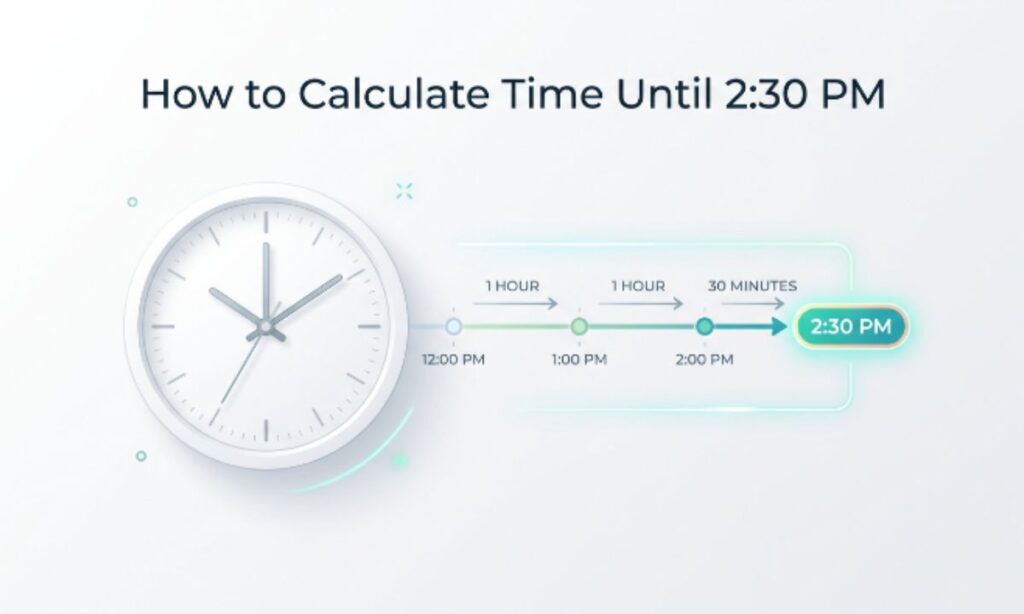
If it’s currently 12:00 PM, the answer is 2 hours 30 minutes. If it’s currently 2:45 PM, the answer flips to roughly 23 hours 45 minutes because 2:30 PM has already passed and the next one lands tomorrow. Same question, completely different answer, depending entirely on the moment you ask it.
How the Countdown Is Calculated
There are really only three situations you’ll ever run into, and each one works a little differently.
If It’s Before 2:30 PM Today
This is the simple case. Subtract your current time from 2:30 PM, and that gap is your answer.
If It’s Exactly 2:30 PM
The countdown hits zero. At this exact moment, the time remaining is zero hours, zero minutes.
If It’s After 2:30 PM
Once 2:30 PM has passed for the day, the target automatically rolls forward to tomorrow’s 2:30 PM. You’re no longer counting down to “today’s” 2:30 PM. You’re counting down to the next one, roughly 24 hours out, minus whatever time has already elapsed since 2:30 PM passed.
How to Calculate Time Until 2:30 PM Manually
You don’t need an app for this. A few simple steps get you there every time, even in the trickier cases most quick guides skip.
Step 1: Convert 2:30 PM to 24-Hour Time
2:30 PM in 24-hour format is 14:30. This step matters because it removes the AM/PM guesswork, especially useful if you’re doing the math with a digital clock or scheduling tool that runs on 24-hour time.
Step 2: Subtract the Current Time
Convert your current time to 24-hour format too, then subtract it from 14:30.
Example: It’s 11:20 AM, or 11:20 in 24-hour time.
14:30 − 11:20 = 3 hours 10 minutes.
Step 3: Handle Minute Borrowing
Here’s where a lot of quick-math guides fall apart. If your current minutes are higher than 30, you can’t just subtract directly; you’ll end up with a negative number of minutes. You need to borrow an hour first.
Example: It’s 1:45 PM (13:45), and you’re counting to 14:30.
Minutes: 30 − 45 doesn’t work, so borrow one hour from the hours column.
That turns 14:30 into 13:90 (14 hours becomes 13, and 30 minutes becomes 90 minutes since 60 minutes equal one hour).
So from 1:45 PM, you’re 45 minutes away from 2:30 PM. This borrowing step is the part that trips up simple subtraction methods, so it’s worth practicing once with a tricky example like this one.
Step 4: Roll Forward to Tomorrow If Needed
If your current time is later than 14:30, add 24 hours to 14:30 before subtracting. That gives you the correct countdown to tomorrow’s 2:30 PM instead of a negative number.
Example: it’s 6:00 PM (18:00).
14:30 + 24:00 = 38:30 (tomorrow’s 2:30 PM, expressed as hours past midnight today).
38:30 − 18:00 = 20 hours 30 minutes.
Examples: Time Remaining Until 2:30 PM
Seeing several examples side by side makes the pattern click faster than reading steps alone.
Current Time
Time Until 2:30 PM
8:00 AM
6 hours 30 minutes
9:45 AM
4 hours 45 minutes
11:20 AM
3 hours 10 minutes
12:50 PM
1 hour 40 minutes
1:45 PM
45 minutes
2:15 PM
15 minutes
2:30 PM
0 minutes (it’s happening now)
3:30 PM
23 hours (until tomorrow)
6:00 PM
20 hours 30 minutes (until tomorrow)
11:59 PM
14 hours 31 minutes (until tomorrow)
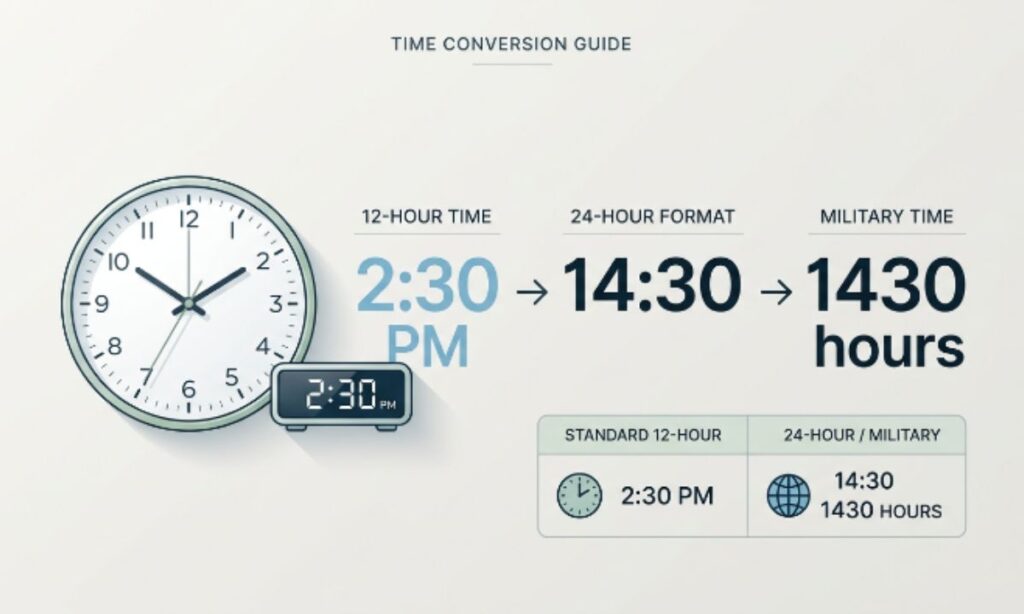
2:30 PM in 24-Hour and Military Time
Quick reference, since this comes up constantly when scheduling across different formats:
12-hour format: 2:30 PM
24-hour format: 14:30
Military time (spoken): “fourteen thirty”
Minutes after midnight: 870
Does Your Time Zone Affect the Countdown?
Yes, and this is worth being deliberate about. “2:30 PM” only means something once you attach it to a specific time zone. If you’re counting down to a meeting scheduled in Eastern Time but you’re sitting in Pacific Time, you need to convert first; otherwise, your countdown will be off by however many hours separate the two zones.
A quick way to avoid mistakes: always confirm whether the 2:30 PM you’re tracking refers to your local time or someone else’s. If it’s tied to a specific event, like a flight or a call with someone in another region, check the time zone attached to that event rather than assuming it matches your device’s clock.
A Note on Daylight Saving Time
If you’re counting down to a 2:30 PM that falls on the day clocks shift forward or back, the actual gap in real elapsed hours can be thrown off by an hour. This mostly matters for countdowns spanning more than a day. For same-day countdowns, it’s rarely an issue, but it’s worth double-checking around the specific dates your region changes its clocks.
Setting a Reminder or Countdown for 2:30 PM
If you’d rather not do mental math every time, a few practical options handle it automatically:
Phone alarm or timer app: Set it directly for 2:30 PM, and your phone handles the countdown in the background.
Voice assistants: Asking Siri, Alexa, or Google Assistant “how long until 2:30 PM” gives you an instant, live answer based on your device’s current time and time zone.
Calendar alerts: If 2:30 PM is tied to a specific meeting or appointment, a calendar reminder is more reliable than a generic countdown, since it’s attached to the actual event and its correct time zone.
Smartwatch complications: Many smartwatches can display a live countdown on the watch face itself, useful if you want a constant visual reminder without checking your phone.
For Anyone Who Can’t See a Visual Countdown
If a visual timer isn’t accessible to you, the manual calculation method above works just as well without needing to see a screen. You can also ask a voice assistant for a spoken answer, which reads the remaining time aloud instead of displaying it visually. Either approach gets you the same accurate result as a graphic countdown.
Why “How Long Until 2:30 PM” Gets Searched So Often
This isn’t idle curiosity for most people. It tends to come up around a specific set of real, practical moments:
Joining a scheduled meeting or conference call
Making it to a doctor, dentist, or salon appointment
School pickup or dismissal timing
Catching a flight, train, or bus
Starting or ending a work shift
Simply wanting to know how much of the afternoon is left
Because 2:30 PM sits squarely in the mid-afternoon, it often marks a natural transition point, past lunch but well before the workday winds down, which is likely part of why it gets searched as often as it does.
Frequently Asked Questions
How long until 2:30 PM today?
It depends on the current time; subtract your current time from 14:30, and if 2:30 PM has already passed, the countdown rolls forward to tomorrow.
What if 2:30 PM has already passed?
The countdown automatically shifts to the next 2:30 PM, roughly 24 hours out minus the time that’s already elapsed since it passed.
How many minutes after midnight is 2:30 PM?
2:30 PM falls exactly 870 minutes after midnight.
What is 2:30 PM in military time?
2:30 PM is written as 1430 and spoken as “fourteen thirty.”
How do I calculate the time until 2:30 PM manually?
Convert both times to 24-hour format, subtract, borrow an hour if your current minutes exceed 30, and add 24 hours if the target time has already passed today.
Conclusion
The time left until 2:30 PM is never a fixed number; it shifts by the second depending on when you check. Once you know the underlying formula, converting to 24-hour time, subtracting carefully, borrowing minutes when needed, and rolling forward to tomorrow after the target passes, you can work it out accurately without any tool at all.
And if you’d rather not do the math, a phone alarm, voice assistant, or calendar reminder will handle it instantly and correctly every time.
I’m a passionate pet writer who loves sharing practical tips, trusted advice, and heartwarming stories about cats, dogs, and other beloved companions. Through PetCaffine.com, I help pet lovers better understand their furry friends with easy-to-read articles on pet care, nutrition, behavior, health, and everyday life.






4 thoughts on “How Long Until 2:30 PM? The Effortless Answer”