How Long Until 3:15 PM? Quick Answer and Simple Formula
Check the clock, do a little mental math, and get it wrong anyway. Sound familiar? Figuring out how long until 3:15 PM should be simple, but the moment you factor in AM/PM or a time that’s already passed, it gets messy fast. Here’s a clean way to work it out every time.
The time remaining until 3:15 PM depends entirely on your current time right now. There’s no fixed answer, since it changes every second.
Here’s the fast method:
Convert 3:15 PM to 24-hour time: 15:15.
Convert your current time to 24-hour format too.
Subtract your current time from 15:15.
If the result is positive, that’s your time remaining today.
If the result is negative, 3:15 PM has already passed, so count forward to 3:15 PM tomorrow instead.
That’s the entire logic. Everything else is just detail.
How to Calculate the Time Until 3:15 PM
Step 1: Note Your Current Local Time
Use the actual time on your device or wall clock. Local time is what matters here, not UTC, unless you’re specifically working across time zones.
Step 2: Convert 3:15 PM to 24-Hour Time
3:15 PM becomes 15:15 in 24-hour format. This step removes any AM/PM confusion before you start subtracting.
Step 3: Subtract to Find Hours and Minutes Remaining
Subtract your current time from 15:15. Do the hours first, then the minutes. If your minutes are higher than 15, borrow an hour and adjust, the same way you’d do clock subtraction on paper.
Step 4: Adjust If 3:15 PM Has Already Passed Today
If your subtraction gives you a negative number, don’t panic. It just means 3:15 PM already happened today. Add 24 hours to your calculation, and the result becomes your countdown to 3:15 PM tomorrow.
Simple Formula for “Time Until 3:15 PM”
Here’s a formula that works no matter what time it is right now:
Minutes until 3:15 PM = (target time in minutes since midnight) − (current time in minutes since midnight)
Where 3:15 PM in minutes since midnight is 15 × 60 + 15 = 915.
If the result is negative, add 1,440 (the number of minutes in a day) to get the countdown to tomorrow’s 3:15 PM instead.
This formula works whether you’re counting hours and minutes manually or building your own quick calculation in a spreadsheet.
Worked Examples
Seeing the math play out with real numbers makes the formula click faster than reading rules alone.
Current Time
Time Until 3:15 PM
1:30 PM
1 hour 45 minutes
2:00 PM
1 hour 15 minutes
3:00 PM
15 minutes
3:15 PM
0 minutes (it’s happening now)
3:20 PM
Passed. Countdown resets to tomorrow: 23 hours 55 minutes
11:45 PM
Passed. Countdown to tomorrow: 15 hours 30 minutes
If It Is 1:40 PM Now
Convert to 24-hour time: 13:40. Subtract from 15:15: 15:15 − 13:40 = 1 hour 35 minutes. That’s your countdown.
If It Is 3:00 PM Now
Subtract 15:00 from 15:15, and you get exactly 15 minutes left. This is the kind of close-to-target case where double-checking your minutes matters most.
Is 3:15 PM Morning or Afternoon?
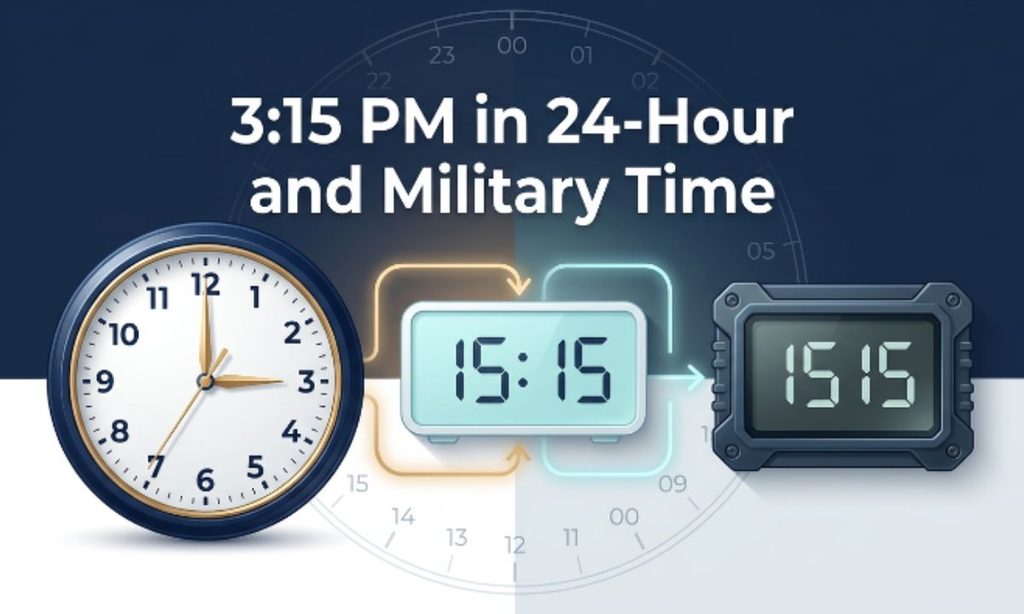
3:15 PM falls in the afternoon. In 24-hour time, it’s written as 15:15, and in military time it’s spoken as “fifteen fifteen” or written as 1515. Anything from 12:00 PM to 5:59 PM sits in the afternoon window, so 3:15 PM is comfortably in the middle of that range.
Quick reference:
3:15 AM = early morning, 03:15 in 24-hour time
3:15 PM = mid-afternoon, 15:15 in 24-hour time
These two are exactly 12 hours apart, so mixing them up throws off your entire calculation. Always confirm which one you mean before subtracting.
3:15 PM in 24-Hour and Military Time
Converting between formats removes a lot of the guesswork from time calculations. Here’s the quick reference:
Standard time: 3:15 PM
24-hour time: 15:15
Military time: 1515 (spoken as “fifteen fifteen”)
Minutes since midnight: 915
If you’re working with any kind of scheduling tool, calendar app, or spreadsheet, converting to 24-hour format first will save you from AM/PM errors almost every time.
How Time Zones Affect the Countdown
“3:15 PM” only means something once you attach a timezone to it. If someone tells you a meeting starts at 3:15 PM without specifying where, you’re missing a critical piece of information.
Here’s how the same target time looks across different zones, using 3:15 PM Eastern Time as the anchor:
Eastern Time: 3:15 PM
Central Time: 2:15 PM
Mountain Time: 1:15 PM
Pacific Time: 12:15 PM
UTC: 7:15 PM (during Eastern Daylight Time)
If your countdown is for a meeting, flight, or deadline set by someone in a different region, convert their 3:15 PM into your local time zone first, then run your countdown from there. Skipping this step is one of the most common reasons countdown timers feel “off.”
What If 3:15 PM Has Already Passed?
This happens constantly, and it’s not a problem, just a branch in the logic. Once the current time passes 3:15 PM, your countdown target automatically shifts to the next occurrence, which is 3:15 PM tomorrow.
To calculate it:
Take the time remaining until midnight.
Add 15 hours and 15 minutes to that.
The total is your countdown to tomorrow’s 3:15 PM.
For example, if it’s 9:00 PM right now, there are 3 hours left until midnight. Add 15 hours 15 minutes, and you get 18 hours 15 minutes until 3:15 PM tomorrow.
Using a Countdown Timer for 3:15 PM
A live countdown timer does this math automatically and updates every second, which is genuinely useful if you want a real-time number instead of a static calculation.
A few practical tips for using one well:
Set the timer once and let it run instead of manually recalculating every few minutes.
Enable a notification or alarm, so you’re not staring at the screen waiting.
Double-check the timer is using your correct local timezone before you rely on it.
If you’re counting toward a recurring daily event, confirm whether the tool automatically rolls over to the next day once 3:15 PM passes.
Checking a countdown too often tends to make the wait feel longer, not shorter. Set it, step away, and let the notification do the work.
Common Mistakes When Calculating Time Until 3:15 PM
A handful of small errors account for most wrong answers:
Confusing 3:15 AM with 3:15 PM. These are 12 hours apart, and mixing them up throws the whole calculation off.
Forgetting the tomorrow rollover. If 3:15 PM already passed, the countdown needs to restart for the next day, not just show a negative number.
Skipping the 24-hour conversion. Subtracting in 12-hour format without converting first is where most manual math errors happen.
Ignoring time zones. A 3:15 PM deadline set by someone else may not be 3:15 PM where you are.
Miscounting minutes when borrowing an hour. If your current minutes are higher than 15, remember to borrow correctly instead of getting a negative minute value.
The fix for nearly all of these: convert everything to 24-hour time and minutes-since-midnight before you subtract anything.
Frequently Asked Questions
How many hours until 3:15 PM?
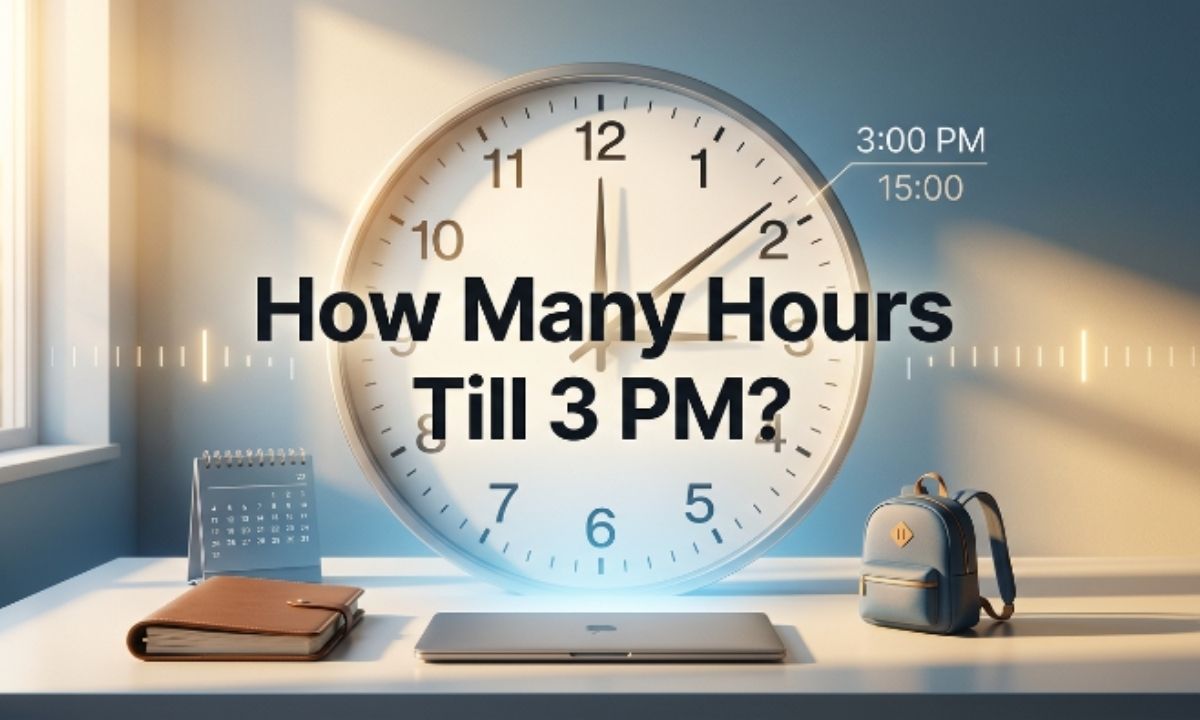
It depends on your current time; subtract your current hour from 15 (in 24-hour format) to get the hour count, then adjust for minutes.
What time is 3:15 PM in 24-hour format?
3:15 PM is written as 15:15 in 24-hour format.
What if 3:15 PM has already passed today?
The countdown automatically shifts to 3:15 PM tomorrow; add the time remaining until midnight to 15 hours 15 minutes.
Is 3:15 PM morning or afternoon?
3:15 PM is in the afternoon, since it falls between 12:00 PM and 5:59 PM.
Does my time zone affect the countdown to 3:15 PM?
Yes, always confirm which timezone the 3:15 PM target refers to before calculating, since the same clock time differs by region.
Conclusion
Working out how long until 3:15 PM comes down to one repeatable process: convert to 24-hour time, subtract your current time from 15:15, and check whether you’ve already passed it today. Once that habit sticks, AM/PM mix-ups and rollover confusion mostly disappear.
Whether you’re counting down to a meeting, a school pickup, or just watching the clock until the end of your shift, the same simple formula gets you a reliable answer every time.
I’m a passionate pet writer who loves sharing practical tips, trusted advice, and heartwarming stories about cats, dogs, and other beloved companions. Through PetCaffine.com, I help pet lovers better understand their furry friends with easy-to-read articles on pet care, nutrition, behavior, health, and everyday life.



1 thought on “How Long Until 3:15 PM? Quick Answer and Simple Formula”