What Time Was It 11 Hours Ago? Here’s the Fast Way to Check
You see “11 hours ago” on a text, a post, or a delivery update, and your brain stalls for a second. Was that late last night or early this morning? Unlike a clean 12-hour gap, 11 hours doesn’t let you just flip AM to PM. Here’s the quick method that actually works.
Quick Answer: Subtract 11 Hours From the Current Time
Take your current time, subtract 11 hours, and adjust the minutes if needed.
If it’s 2:20 PM now, 11 hours ago was 3:20 AM.
If it’s 8:45 AM now, 11 hours ago was 9:45 PM the previous day.
If it’s 10:00 PM now, 11 hours ago was 11:00 AM the same day.
Notice the hour number shifts by more than a simple flip this time. That’s the key difference between 11 hours and 12 hours: with 12, you just swap AM/PM and keep the numbers. With 11, the hour actually moves, which is why people stumble on it more often.
Why 11 Hours Trips People Up More Than 12
Twelve hours is exactly half a day, so the math is a clean mirror image on the clock face. Eleven hours is one hour short of that, which means:
You can’t just flip AM/PM and call it done.
The hour number itself changes by one in addition to the flip.
Small errors compound easily if you’re doing it in your head.
The good news is that once you understand this one extra step, 11 hours becomes just as fast to calculate as 12.
The Simple Rule: Two-Step Subtraction
The easiest way to handle 11 hours is to break it into two smaller, more manageable moves.
Step 1: Subtract 12 hours first (the easy flip). Just swap AM to PM or PM to AM, keeping the numbers the same.
Step 2: Add 1 hour back. Since you actually only wanted to go back 11 hours, not 12, add one hour to correct for the difference.
Worked Example
Say it’s currently 3:53 PM.
Subtract 12 hours → 3:53 AM.
Add 1 hour back → 4:53 AM.
So 11 hours before 3:53 PM is 4:53 AM, same calendar day.
This two-step trick works every time and is far easier than trying to subtract 11 directly in your head.
Examples of 11 Hours Ago at Different Times
Seeing several examples side by side makes the pattern click.
If your current time falls in the early morning, say before 11 AM, subtracting 11 hours pushes you into the previous evening. For example, 9:00 AM minus 11 hours lands at 10:00 PM the day before.
Afternoon to Early Morning
If your current time is in the afternoon or evening, subtracting 11 hours usually keeps you on the same calendar day, landing somewhere in the early morning hours. For example, 5:00 PM minus 11 hours lands at 6:00 AM, same day.
Noon and Midnight Examples
These two are worth memorizing separately since they sit right on the boundary:
Noon minus 11 hours = 1:00 AM, same day.
Midnight minus 11 hours = 1:00 PM, the previous day.
Does the Date Change When You Go Back 11 Hours?
Yes, in most cases, but the exact cutoff point is different from the 12-hour rule.
Because 11 hours is just under half a day, the date rolls back to the previous day whenever your current time is before 11:00 AM. If your current time is 11:00 AM or later, the date usually stays the same.
Quick way to check yourself:
Current time before 11:00 AM → date moves back one day.
Current time at or after 11:00 AM → date stays the same.
This threshold is easy to forget because it’s not a round number like noon. Keep it in mind, especially if you’re dealing with early-morning timestamps.
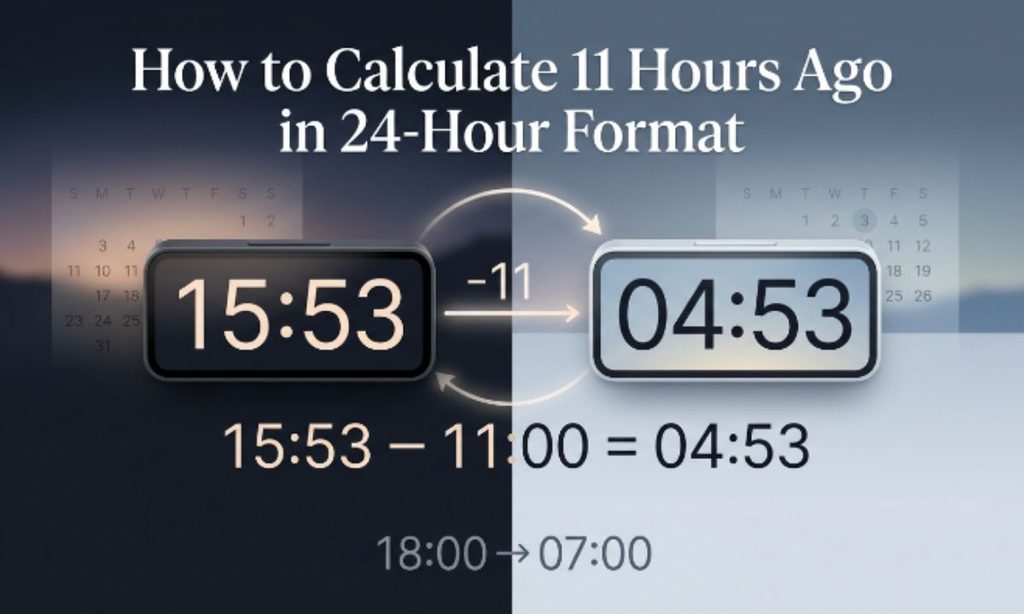
How to Calculate 11 Hours Ago in 24-Hour Format
If you work with 24-hour time, the calculation is pure subtraction, no AM/PM flipping needed.
Formula: 24-hour time − 11:00 = 11 hours ago
Example: it’s 15:53 (3:53 PM).
15:53 − 11:00 = 04:53
That’s 4:53 in 24-hour format, which converts to 4:53 AM.
If subtracting 11 from the hour gives you a negative number, add 24 to the result and move the date back one day.
Example: it’s 06:30.
06 − 11 = −5 → add 24 → 19:00 the previous day, i.e., 7:30 PM the day before, keeping the 30 minutes.
Understanding 11 Hours in Smaller Units
Sometimes it helps to see the interval broken into smaller pieces, especially if you’re doing precise calculations for logs or records.
11 hours = 660 minutes
11 hours = 39,600 seconds
11 hours = 39,600,000 milliseconds
This matters most in technical contexts like server logs or scheduling systems, where timestamps are often stored down to the second or millisecond.
11 Hours Ago Compared to Nearby Intervals
It helps to see how 11 hours sits next to its neighbors, since a lot of people land on this page while actually meaning a slightly different interval.
10 hours ago — one hour closer to now than 11 hours ago.
11 hours ago — the interval covered in this guide.
12 hours ago — a clean AM/PM flip, no hour-number change.
13 hours ago — one hour further back, requires the two-step method in reverse.
If you’re ever unsure which interval you actually need, double-check the app or message you’re reading. Some platforms round to the nearest hour, so “11 hours ago” might really mean anywhere from 10.5 to 11.5 hours.
Why Your Time Zone Matters
An 11-hour calculation only makes sense once you know which time zone you’re working in.
A timestamp on your phone is usually converted to your local time zone automatically, even if the original event happened somewhere else.
If you’re coordinating with someone in a different region, always confirm whose time zone a timestamp reflects before doing the math.
For anything involving multiple locations, it’s safer to convert everything to UTC first, subtract 11 hours there, then convert the result back to each local time zone.
This matters for remote work, international meetings, travel planning, and even online gaming sessions where players are spread across regions.
Does Daylight Saving Time Affect This Calculation?
In most cases, no. Daylight saving time only matters if your 11-hour window happens to cross the exact date a region’s clocks shift.
When clocks fall back, your actual elapsed time is one hour more than the clock difference suggests.
When clocks spring forward, your actual elapsed time is one hour less than the clock difference suggests.
If your calculation doesn’t cross a DST changeover date, you can ignore this entirely. If it does, and precision matters, work in UTC to sidestep the issue completely, since UTC never observes daylight saving.
Common Mistakes When Calculating 11 Hours Ago
A few small slips account for most wrong answers:
Treating 11 hours like 12 hours. A simple AM/PM flip is not enough. You need the extra one-hour adjustment.
Forgetting the date change. Early-morning times often roll back to the previous day, and it’s easy to miss.
Mixing up noon and midnight. Both read as “12” on a standard clock, which reverses their usual AM/PM behavior.
Trusting a rounded app label. “11 hours ago” in a notification is often an approximation, not an exact timestamp.
Skipping the time zone check. The same moment looks different on clocks in different regions.
Ignoring DST near a changeover date. Rare, but it throws off exact calculations when it applies.
When the Exact Time Actually Matters
For casual browsing, a rough estimate is usually fine. But in certain situations, getting the exact time right actually matters:
Work and shift logs, where hours need to be accurate for payroll or billing.
Delivery and shipping updates, where “11 hours ago” affects whether something is running late.
Legal, compliance, or financial deadlines, where a miscalculated hour has real consequences.
International meeting scheduling, where an 11-hour gap can shift a meeting to an entirely different day in someone else’s time zone.
Technical debugging and server logs, where exact timestamps help reconstruct the order of events.
Missed calls or urgent messages, where knowing precisely how long ago something happened affects how you respond.
For these cases, skip the mental math and verify with a calculator or by converting to UTC.
A Reusable Formula for Any “Hours Ago” Question
Once you’re comfortable with 11 hours, the same logic applies to any interval:
Past time = Current time − Elapsed hours
Future time = Current time + Elapsed hours
The two-step trick (subtract 12, then adjust) works well for any interval close to 12 hours, whether that’s 10, 11, 13, or 14. For intervals far from 12, straight subtraction in 24-hour format is usually faster.
Frequently Asked Questions
Is 11 hours ago the same time yesterday?
No, the hour number shifts by one in addition to the AM/PM flip, so it’s not a simple mirror of the current time.
What time was it 11 hours ago if it’s 3 PM now?
It was 4 AM the same day.
Does 11 hours ago mean yesterday or today?
It depends on the current time: before 11 AM usually means yesterday, and 11 AM or later usually means today.
Why does an app say “11 hours ago” when the exact time seems different?
Apps often round timestamps to the nearest hour, so the label is an approximation rather than an exact figure.
Does daylight saving time affect the 11-hour calculation?
Only if the 11-hour window crosses a DST changeover date; otherwise it has no impact.
Conclusion
Working out what time it was 11 hours ago is easiest when you stop trying to subtract 11 directly and instead use the two-step trick: flip 12 hours first, then add one hour back. That single adjustment is the main thing separating this calculation from the cleaner 12-hour version, and it’s the reason so many people pause when they see “11 hours ago” on a screen.
Keep an eye on the date rollover around the 11 AM mark, double-check time zones when more than one location is involved, and you’ll have the right answer every time without reaching for a calculator.
I’m a passionate pet writer who loves sharing practical tips, trusted advice, and heartwarming stories about cats, dogs, and other beloved companions. Through PetCaffine.com, I help pet lovers better understand their furry friends with easy-to-read articles on pet care, nutrition, behavior, health, and everyday life.



1 thought on “What Time Was It 11 Hours Ago? Here’s the Fast Way to Check”