What Time Is 12 Hours From Now? A Simple Way to Find Out
Twelve hours feels like a strange amount of time to picture. It’s not quite “tomorrow,” but it’s not “later today” either. Yet this exact question comes up constantly, whether you’re setting an alarm, planning a night shift, or trying to figure out when a long flight actually lands. Here’s the good news: the math behind it is almost embarrassingly simple once you know the trick.
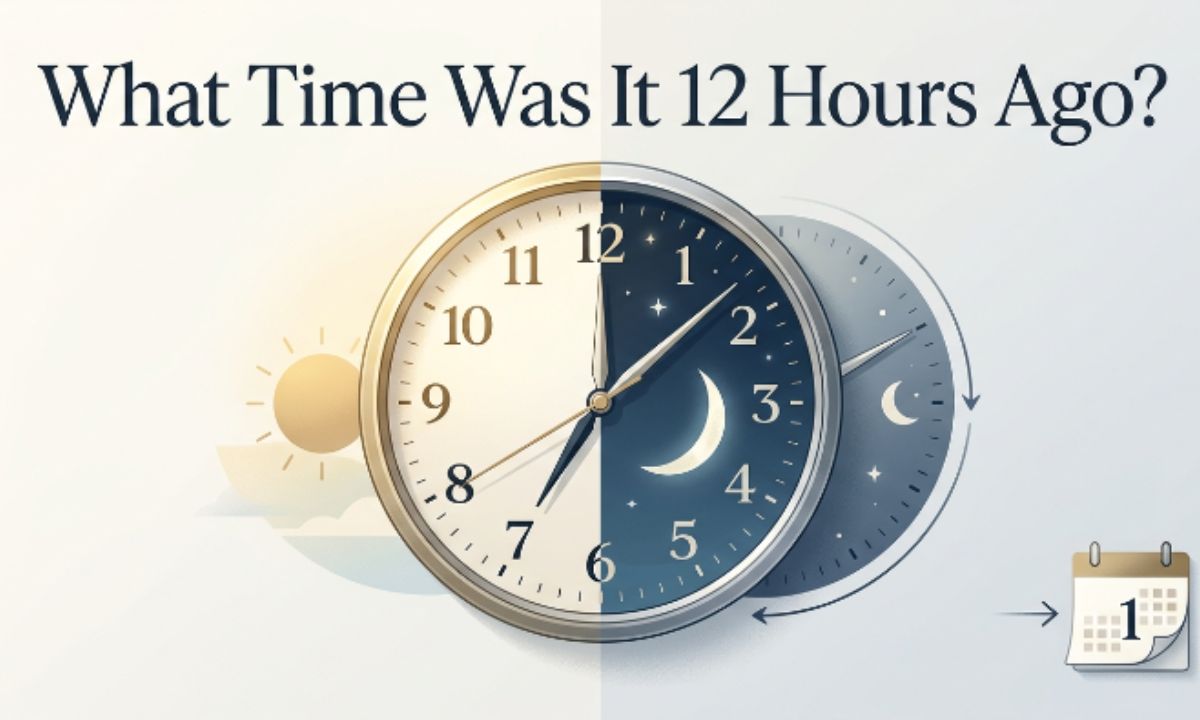
Twelve hours from now lands exactly on the opposite side of the clock face from where you are right now.
Here’s the core rule:
The hour number stays exactly the same
The minutes stay exactly the same
Only the AM/PM label flips
So if it’s 9:00 AM right now, 12 hours from now is 9:00 PM. Same numbers, opposite half of the day. This works because a full day has 24 hours, and 12 is precisely half of that. You’re not moving forward or backward through the clock face; you’re just jumping to its mirror point.
This is different from adding almost any other number of hours, where both the hour and the AM/PM label usually change. Twelve is the one interval that keeps things clean.
The Quick Rule for Calculating 12 Hours From Now
You don’t need a calculator for this one. Just follow three steps:
Note your current hour and minutes
Keep those numbers exactly as they are
Switch AM to PM, or PM to AM
That’s the entire method for a 12-hour clock. A few quick examples:
6:45 AM becomes 6:45 PM
2:30 AM becomes 2:30 PM
7:00 PM becomes 7:00 AM (the next day)
10:10 AM becomes 10:10 PM
11:15 PM becomes 11:15 AM (the next day)
Notice the pattern. Anything starting in the AM hours stays on the same calendar day. Anything starting in the PM hours rolls over into tomorrow. That single detail trips up more people than the actual arithmetic does.
Does the Date Change?
Yes, sometimes, and this is the part people actually get wrong.
Here’s the rule broken down:
Starting in the AM hours (12:00 AM through 11:59 AM) → the result lands later the same day
Starting in the PM hours (12:00 PM through 11:59 PM) → the result lands on the next calendar day
A table makes this easier to see at a glance:
Starting Time
12 Hours Later
Date Change
4:00 AM
4:00 PM
Same day
8:15 PM
8:15 AM
Next day
12:00 AM (midnight)
12:00 PM (noon)
Same day
12:00 PM (noon)
12:00 AM (midnight)
Next day
3:50 PM
3:50 AM
Next day
11:05 AM
11:05 PM
Same day
Midnight and noon are the two edge cases worth remembering separately, since they don’t feel intuitive at first glance.
Calculating 12 Hours From Now on a 24-Hour Clock
If you’re working with military time, hospital schedules, or international timetables, the method looks a bit different but stays just as simple.
The rule:
If the current hour is below 12, add 12 to it
If the current hour is 12 or above, subtract 12 from it
Keep the minutes unchanged either way
A few worked examples:
06:20 becomes 18:20
21:40 becomes 09:40
00:00 becomes 12:00
13:45 becomes 01:45
19:30 becomes 07:30
The 24-hour system actually removes some of the ambiguity that trips people up on the 12-hour clock, since there’s no AM/PM label to flip. You’re just moving 12 positions around a 24-number wheel.
Noon and Midnight: Where People Get Confused
These two points cause more mix-ups than every other hour of the day combined, mostly because “12” doesn’t behave the way people expect.
Clear these up once and you won’t second-guess them again:
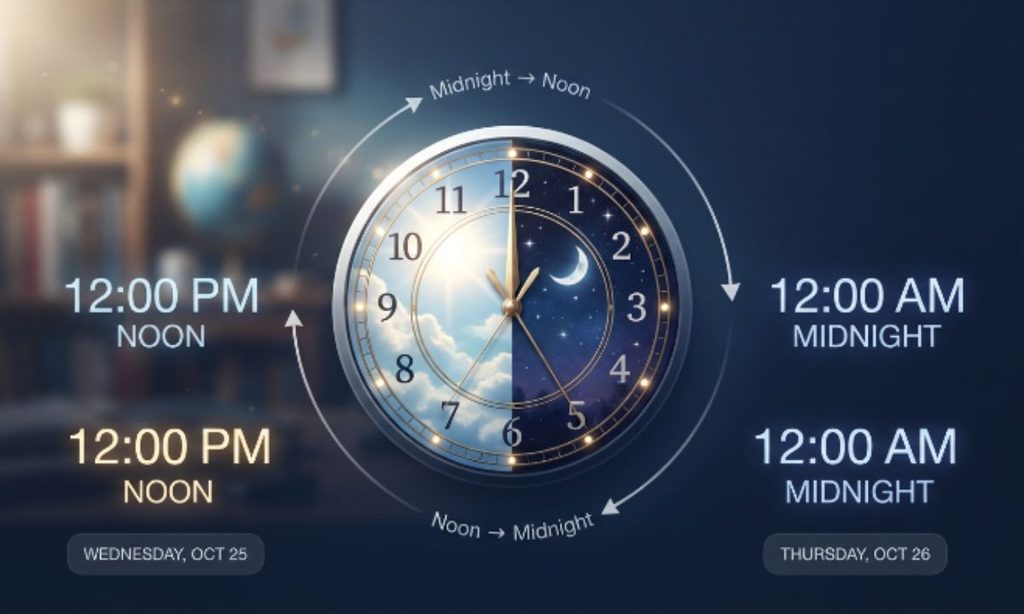
12:00 PM is noon, the middle of the day
12:00 AM is midnight, the start of a new day
Twelve hours after midnight lands you at noon, same calendar day
Twelve hours after noon lands you at midnight, technically the very start of the next day
Because of how often this causes confusion, it’s genuinely worth writing “12 noon” or “12 midnight” in any formal schedule, ticket, or invite. Removing the ambiguity takes two extra words and prevents real mistakes, especially for flights, medical appointments, or contract deadlines.
Why Time Zones Change the Answer
The clock math is identical everywhere in the world. What changes is which actual moment that math points to.
A few things worth knowing:
Twelve hours from now always uses your own local clock unless you specify otherwise
If you’re coordinating with someone in a different region, you need to know their local time, not just apply the 12-hour flip to your own
Time zone offsets (like GMT+5 or UTC-8) don’t change the 12-hour rule itself; they just shift which real-world moment your “now” represents
Daylight Saving transitions can occasionally interfere with this math. If a clock change happens to fall within your 12-hour window, the displayed local time may not shift by a perfectly even 12 hours, even though the actual elapsed time still does
For most everyday planning, this last point won’t matter. But if you’re calculating something precise, like a scheduled system event or a cross-border shift, spanning a daylight saving transition, it’s worth double-checking the actual elapsed hours rather than relying purely on the clock-face flip.
Real-Life Situations Where This Matters
This calculation shows up in more places than people expect.
Work shifts
A 12-hour shift that starts at 7:00 AM ends at 7:00 PM
Night shift workers commonly use this exact flip to plan handover times
Travel and flights
Twelve hours works as a rough first estimate for long-haul flights
You’ll still need to apply the destination’s actual time zone separately to get the true local arrival time
Sleep and daily rhythm
Many people mentally split their day into two 12-hour halves, roughly waking hours and rest hours
A 6:00 AM to 6:00 PM stretch is a common example of this kind of split
Medication and health schedules
Twelve-hour dosing intervals are common for certain medications
Getting the AM/PM flip right here isn’t just convenient; it actually matters for health outcomes
International meetings
Teams across distant time zones sometimes land almost exactly 12 hours apart
The clock-face flip gives a fast mental estimate, though the real scheduling still needs an actual time zone conversion
Manual Calculation vs. Using an Online Tool
Both approaches work. Which one makes sense depends on the situation.
When manual calculation is enough:
Quick daily planning
Simple same-time-zone scheduling
Situations where a rough estimate is fine
When an online calculator is the safer bet:
Cross-time-zone coordination
Anything involving daylight saving transitions
High-stakes timing, like flights, surgeries, or medication schedules
Multi-day or multi-week calculations where manual tracking gets messy
A calculator also removes the guesswork around date rollovers, month-end transitions, and leap years, since it handles the calendar logic in the background instead of asking you to track it in your head.
Common Mistakes to Avoid
A handful of small errors account for most wrong answers here.
Forgetting to flip AM to PM (or PM to AM)
Mixing up noon and midnight
Forgetting that a PM starting time pushes the result into the next day
Applying 12-hour clock logic while working in a 24-hour format, or vice versa
Ignoring time zone differences when coordinating with someone elsewhere
Assuming daylight saving never affects the calculation
Catching these before you finalize a schedule takes seconds and saves the headache of a missed call, a wrong alarm, or a mistimed dose.
Frequently Asked Questions
What time will it be in 12 hours?
Keep your current hour and minutes exactly the same, and just switch AM to PM or PM to AM.
Is 12 hours from now the same time tomorrow?
Only if you’re currently in the PM hours; starting in the AM hours keeps the result on the same day.
What is 12 hours from 9:00 PM?
9:00 AM the next day, since a PM starting time always rolls the result into the following calendar day.
Does daylight saving time affect the 12-hour calculation?
Rarely, but if a clock change falls inside your 12-hour window, the displayed local time may not land exactly 12 hours later.
Is 12:00 AM midnight or noon?
12:00 AM is midnight, marking the very start of a new day, while 12:00 PM is noon.
Conclusion
Figuring out what time it’ll be 12 hours from now really comes down to one clean rule: keep the hour and minutes exactly as they are, and flip AM to PM or PM to AM. The only real traps are noon, midnight, and the date rollover that follows any PM starting time, along with the occasional daylight saving hiccup for those working across time zones.
Once that pattern clicks, you can run the calculation in your head just as fast as any calculator, whether you’re planning a shift, catching a flight, or just setting tomorrow’s alarm.
I’m a passionate pet writer who loves sharing practical tips, trusted advice, and heartwarming stories about cats, dogs, and other beloved companions. Through PetCaffine.com, I help pet lovers better understand their furry friends with easy-to-read articles on pet care, nutrition, behavior, health, and everyday life.





5 thoughts on “What Time Is 12 Hours From Now? A Simple Way to Find Out”