What Time Was It 15 Hours Ago? A Simple Way to Find Out
You glance at a timestamp and your brain freezes for a second. Fifteen hours back from right now… is that yesterday or today? Most people get stuck right at the midnight line. Here’s how to figure it out in seconds, with no guesswork involved.
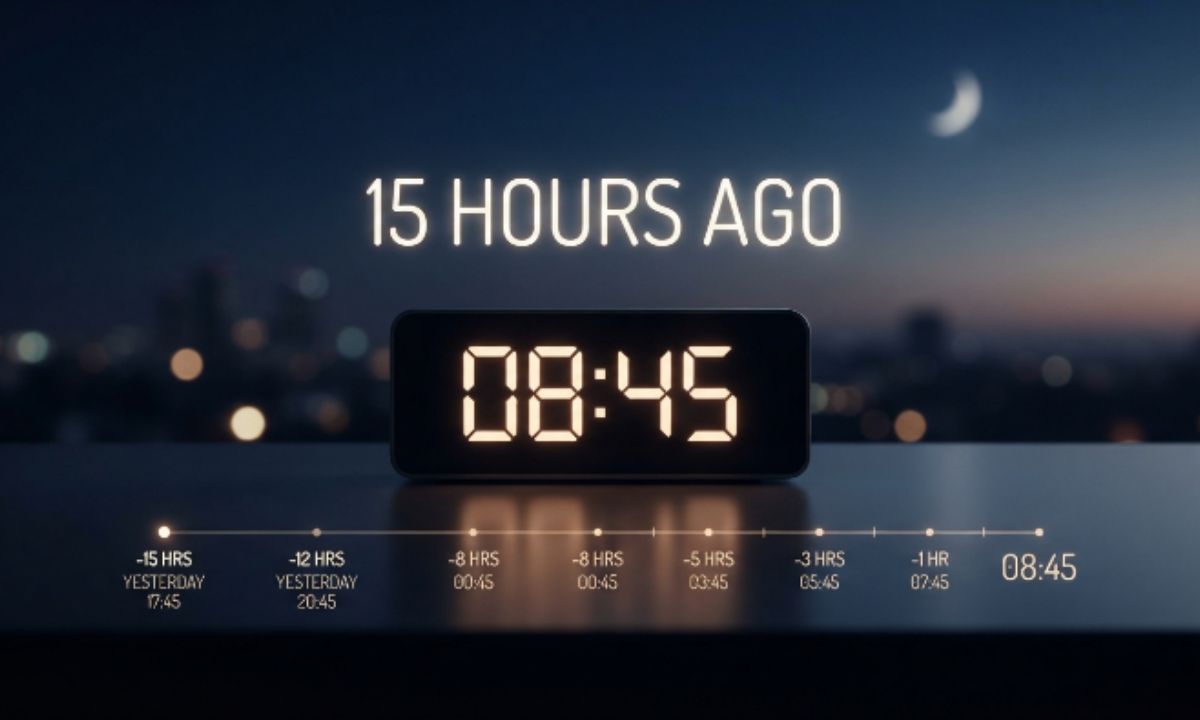
The math is simple: take your current time and subtract 15 hours.
If it’s 6:00 AM right now, 15 hours ago was 3:00 PM the day before. If it’s 9:00 PM right now, 15 hours ago was 6:00 AM the same day.
The tricky part isn’t the subtraction. It’s figuring out whether you landed on today or yesterday. That depends entirely on what time it is right now.
Rule of thumb: if your current time is earlier than 3:00 PM, going back 15 hours pushes you into yesterday. If your current time is 3:00 PM or later, you stay on today’s date.
How to Calculate 15 Hours Ago Manually
You don’t need an app for this. A little mental math gets you there just as fast.
The 12-Then-3 Trick
Fifteen hours splits neatly into 12 + 3. Subtracting 12 hours just flips AM to PM (or PM to AM) without changing the hour number. Then you subtract the last 3 hours from there.
Example: it’s 7:00 PM now.
Subtract 12 hours → 7:00 AM (same calendar day, since we haven’t crossed midnight yet)
Subtract 3 more hours → 4:00 AM
So 15 hours ago was 4:00 AM today.
Using the 24-Hour Clock
If AM/PM mixes you up, switch to military time. It removes the ambiguity entirely.
Example: 7:00 PM becomes 19:00.
19:00 − 15:00 = 04:00
That’s 4:00 AM, confirming the answer above.
This method is especially handy if you work with logs, spreadsheets, or scheduling tools that already display time in 24-hour format.
What to Do When the Number Goes Negative
If subtracting 15 from your current hour gives you a negative number, you’ve crossed into the previous day. Just add 24 to that negative number to get the correct hour, and move the date back by one.
Example: It’s 8:00 AM (hour 8).
8 − 15 = −7
−7 + 24 = 17, which is 5:00 PM
Since you had to add 24, the date moves back one day
So 8:00 AM today, minus 15 hours, equals 5:00 PM yesterday.
Does 15 Hours Ago Mean Yesterday?
Not always. It depends entirely on the current clock time. Here’s a table showing exactly where the line falls.
Current Time
15 Hours Ago
Day
12:00 AM
9:00 AM
Yesterday
3:00 AM
12:00 PM
Yesterday
6:00 AM
3:00 PM
Yesterday
9:00 AM
6:00 PM
Yesterday
12:00 PM
9:00 PM
Yesterday
2:59 PM
11:59 PM
Yesterday
3:00 PM
12:00 AM
Today
6:00 PM
3:00 AM
Today
9:00 PM
6:00 AM
Today
11:59 PM
8:59 AM
Today
Notice the split happens right at 3:00 PM. Anything before that, and going back 15 hours lands you on the previous day. Anything at or after that, and you stay on the current day.
Step-by-Step Examples for Different Times of Day
Sometimes seeing the logic worked out for a few real scenarios makes it click faster than a rule ever will.
Morning example (7:30 AM today):
Subtract 12 → 7:30 PM yesterday
Subtract 3 more → 4:30 PM yesterday
Answer: 4:30 PM yesterday
Midday example (12:00 PM today):
Subtract 12 → 12:00 AM today (technically still today, right at midnight)
Subtract 3 more → 9:00 PM yesterday
Answer: 9:00 PM yesterday
Evening example (9:00 PM today):
Subtract 12 → 9:00 AM today
Subtract 3 more → 6:00 AM today
Answer: 6:00 AM today
Night example (2:00 AM today):
Subtract 12 → 2:00 PM yesterday
Subtract 3 more → 11:00 AM yesterday
Answer: 11:00 AM yesterday
What Happens When You Cross Midnight?
Midnight is where most manual calculations go wrong. People get the hour right but forget to change the date, or they change the date when they shouldn’t have.
Here’s the clean way to think about it. Picture a clock running backward. As the hour hand sweeps past 12:00 AM going in reverse, you step into the previous calendar day. Everything before that point on your countdown still belongs to today; everything after it belongs to yesterday.
The rule: if counting back 15 hours takes you past 12:00 AM, the result is on the previous day. If it doesn’t reach that far back, you’re still on today’s date.
A fast way to check yourself: add 15 hours to your answer. You should land back on your original starting time and date. If you don’t, you made an error somewhere in the date adjustment.
Clock time isn’t the only way to express 15 hours. If you work with code, logs, or scheduling systems, you’ll often see duration written in smaller units.
Unit
Value
Hours
15
Minutes
900
Seconds
54,000
Milliseconds
54,000,000
These conversions matter more than they might seem. Server logs, API timestamps, and analytics platforms frequently store time in seconds or milliseconds since a reference point (often called Unix time). If you’re subtracting 15 hours from a timestamp in code, you’ll usually be working in seconds, not clock hours.
For example, in JavaScript, subtracting 15 hours from the current time looks like this:
That single line does everything the manual method does, including handling the date rollover automatically.
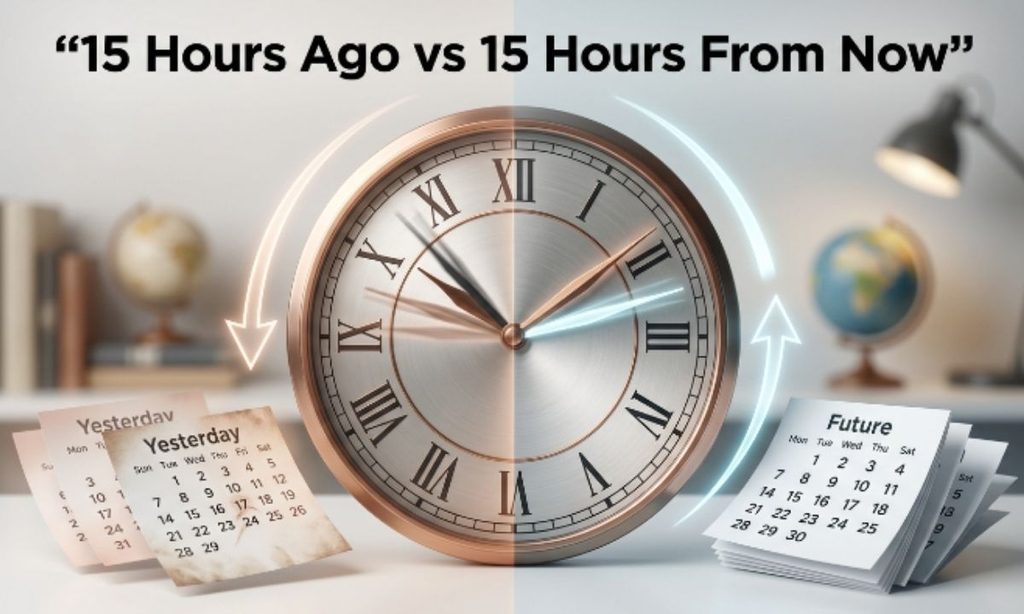
15 Hours Ago vs 15 Hours From Now
15 Hours Ago vs 15 Hours From Now
These two questions use the exact same math, just in opposite directions.
15 hours ago = current time − 15 hours (look backward)
15 hours from now = current time + 15 hours (look forward)
Example starting from 6:00 PM today:
15 hours ago → 3:00 AM today
15 hours from now → 9:00 AM tomorrow
The forward calculation tends to feel more intuitive because most people are used to counting ahead (setting alarms, planning meetings, tracking deadlines). Going backward requires the same steps, just mirrored.
Time Zones and 15 Hours Ago
Fifteen hours is a fixed length of time. It doesn’t stretch or shrink. But the clock reading you land on absolutely changes depending on where you are.
If it’s 6:00 PM in New York, that same moment is a different clock time in London, Tokyo, or Los Angeles. When you calculate “15 hours ago,” you’re working with your own local clock, so the answer only applies to your time zone unless you convert it.
A few things to keep in mind:
Always confirm which time zone you’re calculating in before comparing results with someone else
Daylight saving time can shift the offset by an hour during transition periods
UTC (Coordinated Universal Time) is a useful fixed reference point if you’re coordinating across multiple zones
Apps and calculators that auto-detect your location handle these offsets for you, but double-check the result if precision really matters (payroll, flight schedules, legal timestamps)
If you’re scheduling something international, it’s worth converting both parties’ local times to UTC first, doing the math there, then converting back. It removes a whole category of errors.
Common Mistakes and How to Avoid Them
Almost every error in this kind of calculation comes down to one of a handful of slip-ups.
Forgetting the date change. The hour might be right, but if you crossed midnight, the date needs to move back too.
Mixing up AM and PM. Especially easy to do when the subtraction lands near noon or midnight.
Using the wrong time zone. If you’re comparing notes with someone in another region, confirm whose local time you’re both using.
Skipping daylight saving adjustments. This only matters during the specific weeks when clocks shift, but it trips people up every year.
Treating 12 AM and 12 PM as interchangeable. They’re 12 hours apart, and confusing them throws off the whole calculation.
A quick fix for most of these is to switch to the 24-hour clock while you calculate, then convert back to the 12-hour format at the end. It removes the AM/PM guesswork entirely.
Real-Life Reasons People Ask This Question
This isn’t just an abstract math exercise. People need this answer for genuinely practical reasons.
Checking message or email timestamps to figure out when something was actually sent
Tracking work shifts that span into overtime or overnight hours
Verifying online order or shipment times, especially when a warehouse log shows a different time zone than your own
Reviewing server or security logs where an event needs to be traced back to its origin
Confirming flight departure or connection windows, particularly across time zones
Estimating when a task actually started, based on when you noticed it was finished
For instance, if a shipment tracking page shows a package left the warehouse at a certain timestamp, working backward 15 hours can tell you exactly what time and day that corresponds to in your own local time. The same logic applies to figuring out when an overnight support ticket was actually filed or when a background process kicked off on a server.
Frequently Asked Questions
Is 15 hours ago always yesterday?
No. If your current time is 3:00 PM or later, 15 hours ago still falls on today.
How many minutes are in 15 hours?
15 hours equals 900 minutes.
How many seconds are in 15 hours?
15 hours equals 54,000 seconds.
Does time zone affect the answer?
Yes. The duration stays the same, but the clock time you land on depends on your local time zone.
Can I calculate this without a calculator or app?
Yes. Subtract 12 hours first, then subtract the remaining 3, and adjust the date if you cross midnight.
Conclusion
Figuring out what time it was 15 hours ago really comes down to one thing: subtract 15 hours from your current time and pay close attention to whether you cross midnight along the way.
Use the 12-then-3 trick or switch to the 24-hour clock if AM/PM confuses you, keep time zones in mind when comparing notes with someone elsewhere, and double-check your date whenever the calculation lands near that midnight line. Once you’ve run through it a couple of times, it becomes second nature.
I’m a passionate pet writer who loves sharing practical tips, trusted advice, and heartwarming stories about cats, dogs, and other beloved companions. Through PetCaffine.com, I help pet lovers better understand their furry friends with easy-to-read articles on pet care, nutrition, behavior, health, and everyday life.




2 thoughts on “What Time Was It 15 Hours Ago? A Simple Way to Find Out”