What Time Will It Be in 10 Hours? Quick Guide and Examples
You want to know what time it will be in 10 hours. The answer takes one simple step. Add 10 to the current hour. Then fix AM and PM if you cross noon or midnight. This guide shows you how, with clear examples and ready-made tables. You will also learn how time zones and daylight saving can change the result.
Add 10 hours to your current time. Subtract 12 if the total passes 12. Then flip AM and PM.
Example: it is 9:00 AM. Add 10 and you get 19. Subtract 12 and you get 7. The clock reads 7:00 PM.
Example: it is 4:00 PM. Add 10 and you get 14 on the 12-hour count. That crosses midnight. The clock reads 2:00 AM, and the date moves to tomorrow.
Keep the minutes unchanged. At 4:25 PM, the answer is 2:25 AM.
How Long Is 10 Hours?
Ten hours is a fixed amount of time. It never changes, whatever the clock says.
10 hours equals 600 minutes.
10 hours equals 36,000 seconds.
10 hours equals about 0.42 of a day.
To get minutes, multiply 10 by 60. To get seconds, multiply 600 by 60. And To see how much of a day it covers, divide 10 by 24.
Ten hours is a little more than two-fifths of a full day. It is longer than a standard workday and shorter than a long-haul flight.
How to Calculate 10 Hours From Now Step by Step
You do not need a calculator. Follow three steps.
Step One: Note the Current Time
Read your clock. Write down the hour, the minutes, and AM or PM.
Step Two: Add 10 to the Hour
Add 10 to the hour number only. Leave the minutes alone.
Step Three: Fix the Clock Format
If the new hour is above 12, subtract 12. If you crossed noon or midnight, switch AM to PM or PM to AM. And if you crossed midnight, add one day to the date.
Example: it is 6:40 PM. Add 10 to 6 and you get 16. Subtract 12 and you get 4. You crossed midnight, so the answer is 4:40 AM tomorrow.
Adding 10 Hours on a 12-Hour Clock
The 12-hour clock needs one extra check. Watch for noon and midnight.
A simple shortcut helps. Adding 10 hours equals adding 12 hours and then taking away 2. Adding 12 flips AM and PM and keeps the hour. Taking away 2 shifts the hour back.
Example: it is 8:00 AM. Add 12 and you get 8:00 PM. Take away 2 and you get 6:00 PM.
Example: it is 8:00 PM. Add 12 and you get 8:00 AM the next day. Take away 2 and you get 6:00 AM.
This method works every time. It is the fastest mental trick for this task.
Adding 10 Hours on a 24-Hour Clock
The 24-hour clock removes AM and PM. You add 10 and check one rule. If the total reaches 24 or more, subtract 24 and move to the next day.
Example: it is 09:00. Add 10 and you get 19:00. That equals 7:00 PM.
Example: it is 16:00. Add 10 and you get 26. Subtract 24 and you get 02:00. The date moves forward one day.
Many people find this version easier. It has no AM and PM to mix up. Pilots, nurses, and engineers rely on it for that reason.
What Happens When You Cross Midnight or Noon?
Crossing noon flips AM to PM. Crossing midnight flips PM to AM and moves the date forward. Keep these two rules in mind.
Any start time from 2:00 PM onward lands on tomorrow. Adding 10 hours to 2:00 PM gives 12:00 AM tomorrow. Adding 10 hours to anything later pushes you further into the next day.
Any start time before 2:00 PM stays on today. Adding 10 hours to 1:59 PM gives 11:59 PM today.
Use 2:00 PM as your dividing line. It tells you at once whether the date changes.
Quick Reference: 10 Hours From Morning Times
Find your starting time in the table. Read the answer.
Start time
10 hours later
Date
1:00 AM
11:00 AM
Same day
2:00 AM
12:00 PM
Same day
3:00 AM
1:00 PM
Same day
4:00 AM
2:00 PM
Same day
5:00 AM
3:00 PM
Same day
6:00 AM
4:00 PM
Same day
7:00 AM
5:00 PM
Same day
8:00 AM
6:00 PM
Same day
9:00 AM
7:00 PM
Same day
10:00 AM
8:00 PM
Same day
11:00 AM
9:00 PM
Same day
Every morning start stays on the same date. That makes planning simple.
Quick Reference: 10 Hours From Afternoon and Evening Times
The later you start, the sooner you hit tomorrow.
Start time
10 hours later
Date
12:00 PM
10:00 PM
Same day
1:00 PM
11:00 PM
Same day
2:00 PM
12:00 AM
Next day
3:00 PM
1:00 AM
Next day
4:00 PM
2:00 AM
Next day
5:00 PM
3:00 AM
Next day
6:00 PM
4:00 AM
Next day
7:00 PM
5:00 AM
Next day
8:00 PM
6:00 AM
Next day
9:00 PM
7:00 AM
Next day
10:00 PM
8:00 AM
Next day
11:00 PM
9:00 AM
Next day
Notice the row for 12:00 AM too. If you start at midnight, 10 hours later is 10:00 AM on the same date.
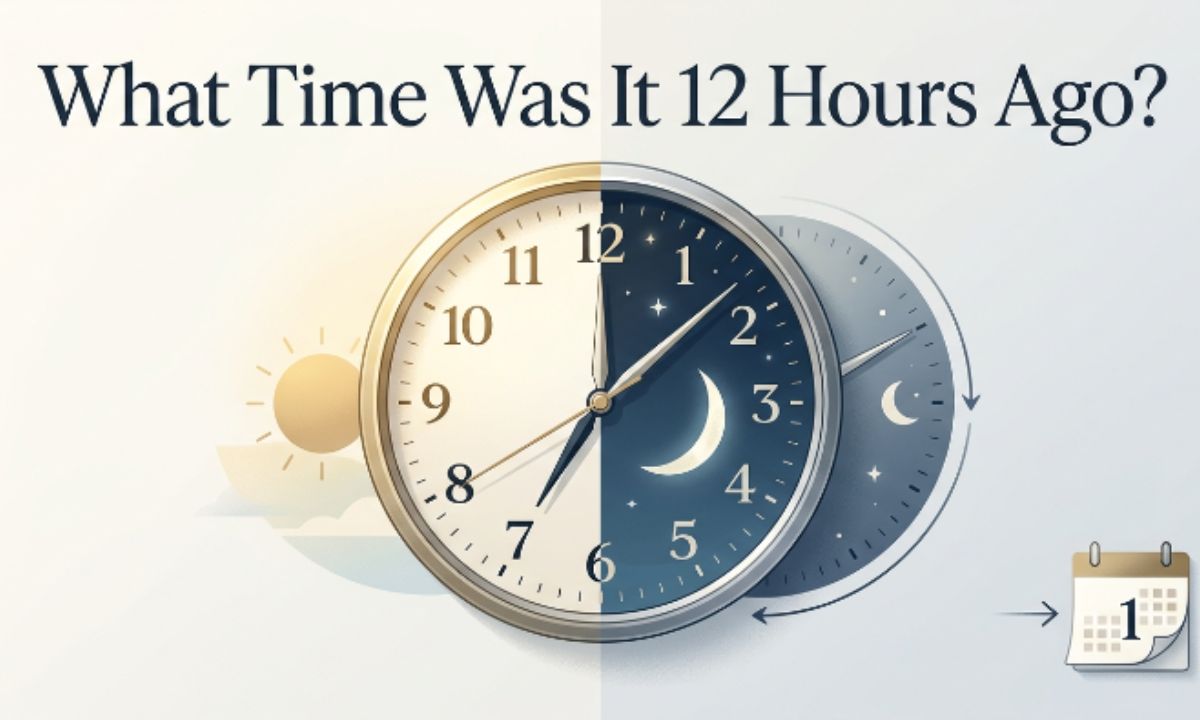
What Time Was It 10 Hours Ago?
Subtract 10 hours instead of adding them. The same rules apply in reverse.
Example: it is 3:00 PM. Subtract 10 and you get 5:00 AM the same day.
Example: it is 6:00 AM. Subtract 10 from 6 and you get negative 4. Add 12 to fix it and you get 8. Because you crossed midnight backward, the answer is 8:00 PM yesterday.
There is a shortcut here too. Going back 10 hours equals going back 12 and then moving forward 2. At 6:00 AM, back 12 gives 6:00 PM yesterday. Forward 2 gives 8:00 PM yesterday.
Do not mix up “ago” and “from now.” One looks backward and the other looks forward. Mixing them gives you an answer 20 hours off.
Yes and no. The span of 10 hours stays the same everywhere. The clock reading differs from place to place.
If you stay in one zone, you add 10 to your local time. Done. If you work with another city, you must convert first and then add.
Here is an example. Say it is 3:00 PM in Coordinated Universal Time right now. The table shows the time in several regions now and 10 hours later. It uses standard time.
Region
Offset
Time now
In 10 hours
Los Angeles (standard)
−8:00
7:00 AM
5:00 PM
New York (standard)
−5:00
10:00 AM
8:00 PM
London (winter)
+0:00
3:00 PM
1:00 AM, next day
Dubai
+4:00
7:00 PM
5:00 AM, next day
Pakistan
+5:00
8:00 PM
6:00 AM, next day
India
+5:30
8:30 PM
6:30 AM, next day
Tokyo
+9:00
12:00 AM, next day
10:00 AM, next day
The gap between cities never changes. Pakistan stays five hours ahead of London in winter. Add 10 hours to both and that gap holds.
What About 10 Hours From Now in GMT+5?
GMT+5 is the zone Pakistan uses. If your device is set to it, add 10 to your local time. Nothing else changes.
Example: it is 3:00 PM in GMT+5. Ten hours later it is 1:00 AM the next day.
Does Daylight Saving Time Affect a 10-Hour Calculation?
It can. A daylight saving change shifts the clock by one hour. If your 10-hour window crosses that moment, the clock reading changes by an extra hour.
Spring forward skips an hour. Say the clock jumps from 2:00 AM to 3:00 AM on Sunday. You check the time at 11:00 PM on Saturday. Ten real hours later, the clock reads 10:00 AM, not 9:00 AM.
Fall back repeats an hour. Say the clock moves from 2:00 AM back to 1:00 AM. You check at 11:00 PM on Saturday. Ten real hours later, the clock reads 8:00 AM, not 9:00 AM.
Many regions never use daylight saving. For those, nothing changes. For the rest, check the transition date before you plan an exact-hour task, such as a flight or a shift.
Real-Life Uses of Calculating 10 Hours From Now
People add 10 hours more often than you might expect. Here are common cases.
Work Shifts and Overtime
A 10-hour shift is common in many jobs. If you start at 7:00 AM, you finish at 5:00 PM. Subtract unpaid breaks to get your paid hours. A 30-minute lunch gives 9.5 paid hours.
Flights and Travel
Long flights often last close to 10 hours. If you depart at 9:00 PM and fly for 10 hours, your clock says 7:00 AM at arrival, before you adjust for the time zone of your destination. Always apply the time zone change after you add the flight time.
Remote Workers and Freelancers
Team members spread across zones need clear handoffs. If a task goes out at 5:00 PM and a teammate needs 10 hours, the draft lands at 3:00 AM your time. Plan deadlines around the receiver’s day, not yours.
Students
A 10-hour study plan fits across a weekend. Break it into five two-hour sessions. Count the start and end times with the same method.
Medication Schedules
Some schedules use fixed gaps between doses. Follow the exact instructions from your doctor or pharmacist. Use the 10-hour method only to find the clock time they described.
Online Gaming and Events
Timers in games and events often count in hours. If a reward resets in 10 hours, add 10 to your current time. Set an alarm so you do not miss it.
How Digital Systems Calculate Future Time
Computers do not use AM and PM. They store time as a single count, often in seconds since a fixed starting point. To add 10 hours, they add 36,000 seconds.
This approach avoids the rollover problems people face. The date, the month, and the year update on their own. Software then converts the result to your local zone for display.
Developers often write timestamps in a standard format such as 2026-01-15T14:30:00Z. The letter Z means Coordinated Universal Time. Using one standard format prevents mix-ups between regions.
In a spreadsheet, you can do the same thing. Add a time value to a cell with the formula =A1+TIME(10,0,0). You can also write =A1+10/24. Both formulas add exactly 10 hours.
12-Hour Clock vs. 24-Hour Clock
Both clocks show the same time. They just label it differently.
The 12-Hour Clock
The 12-hour clock splits the day into two halves. AM covers midnight to noon. PM covers noon to midnight. It suits daily conversation.
The 24-Hour Clock
The 24-hour clock counts from 00:00 to 23:59. It removes AM and PM. It suits schedules, transport, and technical work.
If you struggle with rollovers, switch to the 24-hour clock for your math. Then convert the answer back.
Common Mistakes When Adding 10 Hours
Watch for these errors.
Forgetting midnight. After 2:00 PM, the result falls on tomorrow.
Confusing 12 AM and 12 PM. 12 AM is midnight. 12 PM is noon.
Changing the minutes. Adding whole hours never alters the minutes.
Ignoring time zones. Convert first. Add second.
Mixing “ago” and “from now.” Forward and backward give different answers.
Forgetting the date. Always state whether the result is today or tomorrow.
One habit prevents most errors. Say the answer aloud with the day name. For example, say “2:00 AM Friday.” That small step catches date slips.
Frequently Asked Questions
What time is 10 hours from now?
Add 10 to your current hour, subtract 12 if needed, and switch AM and PM.
How many minutes and seconds are in 10 hours?
Ten hours equals 600 minutes, or 36,000 seconds.
What is 10 hours from 8 PM?
Ten hours from 8 PM is 6 AM the next day.
Does 10 hours from now change the date?
Yes, if your starting time is 2:00 PM or later.
What time was it 10 hours ago?
Subtract 10 from your current hour and fix AM and PM, moving back a day if you cross midnight.
Conclusion
Finding what time it will be in 10 hours takes three quick steps: add 10 to the hour, fix AM and PM, and check whether the date changes. Use 2:00 PM as your dividing line, since any start time after it lands on tomorrow. Convert time zones before you add, watch for daylight saving changes, and use the 24-hour clock if the 12-hour version slows you down. With these habits and the tables above, you can answer this question in seconds, anywhere, for any starting time.
I’m a passionate pet writer who loves sharing practical tips, trusted advice, and heartwarming stories about cats, dogs, and other beloved companions. Through PetCaffine.com, I help pet lovers better understand their furry friends with easy-to-read articles on pet care, nutrition, behavior, health, and everyday life.