You’ve seen “asl” pop up everywhere online. Sometimes it’s tucked at the end of a sentence. Sometimes it shows up alone with a question mark. The letters look the same, but the meaning shifts depending on where and how they’re used. This guide walks through every major meaning of ASL, how to tell them apart, and what to do if a stranger sends it to you.
ASL Has More Than One Meaning, and That’s the Whole Problem
Three letters, three very different meanings. That’s the core issue with “ASL,” and it’s why so many people end up confused the first time they see it.
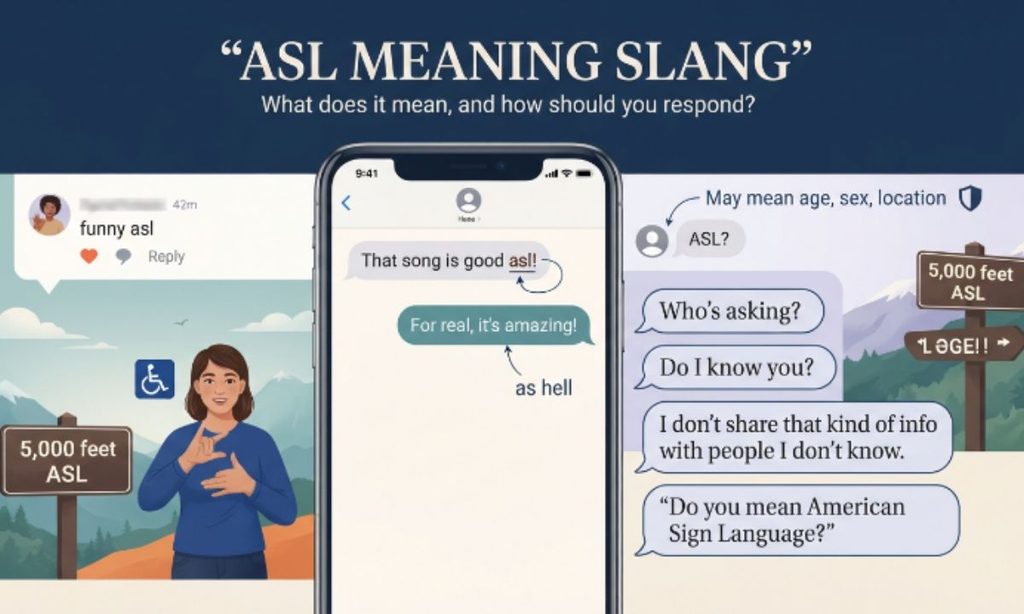
Depending on context, ASL can stand for:
“As hell” — a modern slang intensifier
“Age, sex, location” — an older internet question asking for personal details
American Sign Language — an actual, complete language used by Deaf communities
There’s also a fourth, non-slang use: above sea level, which shows up in geography, hiking, and weather reports. It’s not internet slang, but it’s worth knowing so you don’t confuse it with the others.
The letters never change. The meaning always depends on the sentence around them.
“As Hell” — The Version You’re Probably Seeing Most Right Now
If you’ve noticed “asl” showing up in comments or texts lately, this is almost certainly what’s meant. It’s a shortened, lowercase way of writing “as hell,” used purely for emphasis.
It works like this:
“I’m hungry asl” → I’m extremely hungry.
“That movie was scary asl” → The movie was terrifying.
“She’s funny asl” → She’s hilarious.
“This test was hard asl” → This test was extremely difficult.
The pattern is simple. “Asl” comes right after an adjective. People usually write it in lowercase. They rarely add a question mark.
It works like “very,” “really,” or “extremely.” The difference is that “asl” adds a casual, slang-heavy tone. It makes the statement sound stronger without adding extra words.
Why People Use It Instead of Just Saying “Very”
Slang like this spreads because it saves time and adds attitude. “Funny asl” feels more expressive than “very funny,” even though both mean almost the same thing.
It also shows that you’re speaking casually. That matters in texting, where people often use short, informal language to sound natural and relaxed.
Where “As Hell” Shows Up Most
TikTok captions and comments
Instagram replies
Group chats and iMessage
Twitter/X posts
Casual conversations between friends
You’ll rarely see this version in a professional email or a school assignment, and for good reason. It’s built entirely for informal spaces.
“Age, Sex, Location” — The Older Meaning You Still Need to Know
Before “as hell” took over, ASL had a different, more well-known meaning online: a quick way of asking someone for their age, sex, and general location.
This version usually looks like:
“ASL?”
“A/S/L?”
“What’s your ASL?”
Unlike the lowercase intensifier, this meaning typically appears as a standalone question. There’s no adjective attached. It’s just three letters, often followed by a question mark, sent by someone who wants basic information about you.
Where This Meaning Comes From
The phrase became popular in internet chatrooms during the 1990s and 2000s. People used these anonymous spaces to talk with strangers.
Without profile pictures or bios, “ASL?” gave users a quick way to ask about someone’s age, sex, and location before continuing the chat. It helped them get basic details without a long introduction.
It carried over into platforms like:
Early instant messaging services
Anonymous chat sites
Online dating spaces
Some early gaming chats
Does Anyone Still Use It Today?
Yes, though less often than in its heyday. You’ll still occasionally see “ASL?” pop up from strangers on:
Snapchat
Discord
Anonymous chat platforms
Direct messages from unfamiliar accounts
If someone you don’t know sends this to you out of nowhere, it’s worth pausing before answering.
Is It Safe to Answer an “ASL?” Question?
Short answer: be careful, especially with strangers.
Here’s the practical reasoning. Age, sex or gender, and location might each seem harmless individually. But combined, they can help someone build a more specific picture of who you are and where you might be found. That’s especially risky for younger users.
A few sensible ground rules:
Never share an exact address, just a general area if you choose to answer at all
Avoid giving out your phone number, school name, or workplace
You’re not obligated to answer at all, especially from someone you don’t know
If the account feels off, it’s fine to ignore, block, or report it
Safer Ways to Respond
Instead of answering directly, you can respond with something like:
“Who’s asking?”
“Do I know you?”
“I don’t share that kind of info with people I don’t know.”
These responses keep the conversation open without handing over anything identifying. If the person keeps pushing after a response like this, that’s usually a sign to stop replying altogether.
American Sign Language — The Meaning With Real Cultural Weight
Beyond texting slang, ASL also means American Sign Language. It is a complete language used by Deaf and hard-of-hearing communities across the United States and parts of Canada.
ASL is not English translated into hand gestures. It has its own grammar, sentence structure, and regional variations. Like spoken languages, it has its own rules and ways of expression.
You’ll usually see this meaning in sentences like:
“I’m learning ASL so I can talk with my Deaf coworker.”
“Do you know ASL?”
“We need an ASL interpreter for this event.”
“She teaches an ASL class on weekends.”
How to Recognize This Meaning Instantly
A few contextual signals almost always point to American Sign Language rather than slang:
Mentions of Deaf culture, interpreters, or accessibility
Educational settings, like classes or certifications
Conversations about communication with a Deaf family member or friend
The word appearing as a subject, not tacked onto an adjective
If someone says “ASL is beautiful to watch,” they’re clearly not talking about intensifying an adjective. That sentence only makes sense with the language meaning.
Above Sea Level — The Non-Slang Meaning Worth Knowing
This one has nothing to do with texting or internet culture, but it explains why ASL shows up in unexpected places like weather reports and travel guides.
“Above sea level” measures elevation. You’ll see it in sentences like:
“The town sits at 4,500 feet ASL.”
“This trail climbs to 6,000 feet ASL.”
If you come across ASL in a geography, hiking, or elevation context, this is almost certainly the meaning, and it has zero connection to the slang uses above.
Because the letters stay the same, context gives you the best clue. Look at where ASL appears in the sentence and what words surround it.
Clue
Likely Meaning
Comes after an adjective, such as “funny asl” or “tired asl”
As hell
Stands alone as a question, such as “ASL?”
Age, sex, location
Appears with words like “interpreter,” “Deaf,” “class,” or “language”
American Sign Language
Follows a number and unit, such as “5,000 feet ASL”
Above sea level
Capitalization can also help. People often capitalize “ASL?” when they use it as a question. In slang, they often write “asl” in lowercase. Still, don’t depend on capitalization alone. People use casual typing styles in many contexts. Sentence structure and surrounding words provide the strongest clues.
A Quick Decision Guide
If you’re still not sure which ASL you’re looking at, run through this in order:
Is it attached to an adjective, with no question mark? → Probably “as hell”
Is it a standalone question, especially from a stranger? → Probably “age, sex, location”
Is the topic deaf culture, interpreting, or learning a language? → Almost certainly American Sign Language
Is there a number and a unit like “feet” or “meters” right before it? → Above sea level
This four-step check covers most situations you’ll come across.
Is “As Hell” Considered Rude or Inappropriate?
It’s informal, and that’s the main thing to know. Because it literally abbreviates “as hell,” it’s mildly casual language rather than something formal or polite.
That means it’s generally fine in:
Texting with friends
Social media comments
Casual conversations
But it’s not a great fit for:
Professional emails
School assignments
Customer-service messages
Academic writing
In those settings, swapping it for “very,” “extremely,” or “particularly” reads much more polished without losing the emphasis you’re going for.
How ASL Compares to Similar Texting Abbreviations
ASL isn’t the only short slang term that intensifies a sentence. A few similar examples:
AF — works almost identically to “as hell,” short for “as f***”
FR — short for “for real,” used to confirm something is genuinely true
TBH — “to be honest,” used to preface a candid opinion
What makes ASL a little trickier than these is that it also carries two completely unrelated older meanings. AF and FR don’t really have that same baggage.
The Bottom Line on Reading ASL Correctly
Getting ASL right comes down to habit more than memorization. Once you start noticing sentence position, punctuation, and topic, the correct meaning usually becomes obvious within a few words. It’s one of those slang terms where context does almost all the work, and the letters themselves tell you very little on their own.
Frequently Asked Questions
What does ASL mean in slang?
In slang, ASL usually means “as hell.” People use it after an adjective to add emphasis. Depending on the context, ASL can also mean “age, sex, location.”
What does “ASL?” mean when a stranger sends it?
It usually asks for your age, sex or gender, and general location. Be careful when sharing personal details with strangers. You can also choose not to answer.
What does “funny asl” mean?
“Funny asl” means “extremely funny.” Here, “asl” works as a casual slang form of “as hell.”
Is ASL the same as American Sign Language?
It depends on the context. If the conversation involves Deaf culture, interpreters, classes, or language learning, ASL likely means American Sign Language. In casual texting, it may refer to slang instead.
Is it safe to share your age, sex, and location online?
Avoid sharing personal details with strangers. Keep your information general, and never reveal details that could expose your exact location or identity.
Conclusion
ASL has several meanings. It can work as a slang intensifier, refer to “age, sex, location,” or mean American Sign Language. Context reveals which meaning fits. Check the words around ASL to understand what the writer means.
I’m a passionate pet writer who loves sharing practical tips, trusted advice, and heartwarming stories about cats, dogs, and other beloved companions. Through PetCaffine.com, I help pet lovers better understand their furry friends with easy-to-read articles on pet care, nutrition, behavior, health, and everyday life.







1 thought on “ASL Meaning in Slang: What It Really Stands For”