You’re scrolling through a text or a TikTok comment, and you hit “ICL.” No context clues jump out at you. Don’t worry, this one’s easy once you know the trick. ICL almost always means “I Can’t Lie,” a quick way people signal they’re being honest. It shows up before opinions, confessions, compliments, and blunt takes. This guide covers exactly how it’s used, where you’ll see it, and the few other meanings it can carry outside of texting.
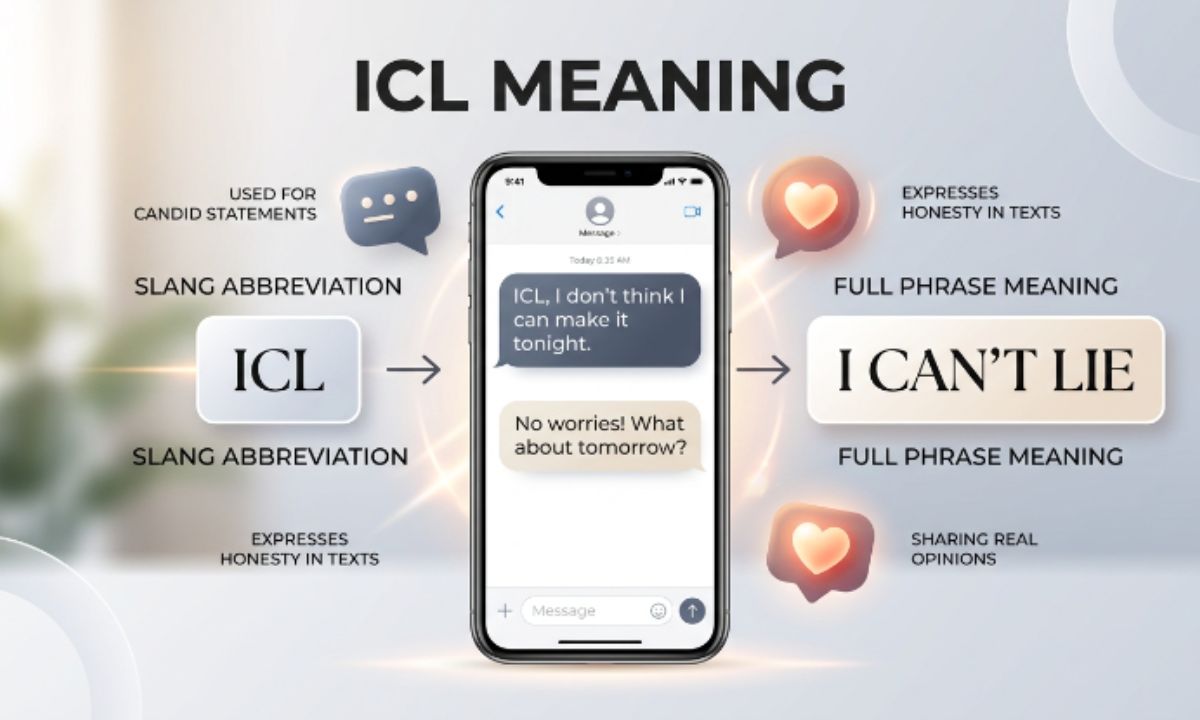
ICL stands for “I Can’t Lie.” It’s an internet acronym people use right before sharing something honest, whether that’s an opinion, a feeling, or a reaction they want to seem genuine.
Think of it as a verbal nudge that says, “What I’m about to say is real, not exaggerated.” It works a lot like:
“Honestly”
“To be real”
“I won’t lie.”
“Not gonna lie”
The acronym itself doesn’t carry emotion. It’s neutral. Whatever comes after ICL determines whether the message sounds positive, negative, or somewhere in between.
Why People Say “I Can’t Lie” Before an Opinion
There’s a reason this phrase caught on beyond just being short. Saying “I can’t lie” before a statement does a few things at once:
It signals honesty, even about something small.
It softens criticism, making a blunt opinion feel less harsh.
It adds emotional weight to a compliment or confession.
It makes the statement feel more personal and less rehearsed.
People use it the same way they’d use “honestly” in spoken conversation, except it’s faster to type and fits the tone of casual online chat better.
Is ICL Positive, Negative, or Neutral?
On its own, ICL is neutral. The tone comes entirely from the sentence around it. Here’s what that looks like in practice:
Tone
Example
Positive
“ICL, I’m really proud of you.”
Neutral
“ICL, I forgot about the meeting.”
Negative
“ICL, that wasn’t what I hoped for.”
Notice the acronym stays the same in all three. Only the words following it change the emotional weight of the message.
How ICL Is Used in Texting
ICL shows up in a handful of common situations. Recognizing these patterns makes it easier to read tone quickly.
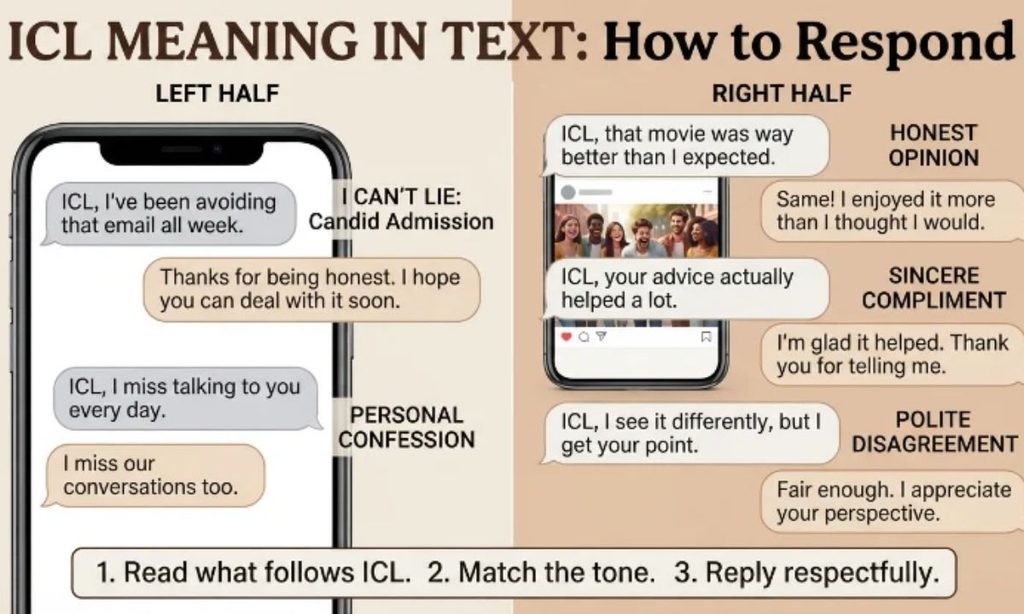
Sharing an honest opinion: “ICL, that movie was way better than I expected.”
Confessing: “ICL, I’ve been avoiding that email all week.”
Giving a compliment: “That outfit is amazing, ICL.”
Reacting to something online: “ICL, this video had me laughing for ten minutes.”
Voicing a blunt or unpopular take: “ICL, I don’t get the hype around that show.”
Agreeing with someone: “ICL, you’re completely right about that.”
Softening disagreement: “ICL, I see it differently, but I get your point.”
Across all of these, the pattern stays consistent: ICL introduces something the sender wants you to take at face value.
Where Does ICL Go in a Sentence?
ICL is flexible. Most of the time it opens the sentence, but it can land anywhere for emphasis.
At the start: “ICL, that pizza was incredible.”
At the end: “That pizza was incredible, ICL.”
In the middle (less common): “That pizza, ICL, was incredible.”
There’s no strict rule here. People place it wherever it feels natural in the flow of the message. Lowercase “icl” and uppercase “ICL” mean the same thing; casual texting doesn’t usually bother with capitalization rules.
One thing worth noting: using ICL more than once or twice in a single conversation starts to lose its punch. It works best as an occasional emphasis tool, not a constant sentence-starter.
ICL Text Examples
Seeing a range of examples side by side helps cement how flexible this acronym really is.
“ICL, I didn’t think it would work, but it did.”
“ICL, I miss talking to you every day.”
“ICL, that concert was the best one I’ve been to.”
“I was nervous at first, but ICL—it turned out fine.”
“ICL, I’ve rewatched that show three times already.”
“ICL, your advice actually helped a lot.”
“ICL, I don’t think that restaurant deserves the hype.”
“ICL, I cried a little during that ending.”
Every one of these follows the same formula: state the honest thing, use ICL to signal it’s genuine.
ICL Meaning on TikTok
TikTok is where ICL shows up constantly, mostly in captions, comments, and spoken audio.
Before a hot take: creators often open with ICL to frame an opinion as candid rather than performative.
Before a confession: ICL introduces something personal the creator wants to admit.
In comment sections: viewers reply with ICL before agreeing or disagreeing with a video’s point.
What Does “TS PMO ICL” Mean?
You may have seen this longer phrase floating around TikTok. It expands to “This Shit Pisses Me Off, I Can’t Lie.” It became popular as a meme-style phrase, often used humorously or dramatically rather than as a literal complaint. If you see ICL stacked with other abbreviations like this, break the phrase down piece by piece rather than trying to guess the whole thing at once.
ICL Meaning on Snapchat and Instagram
The core meaning doesn’t shift across platforms, but the tone and setting do.
On Snapchat:
Common in direct messages and captions under photos.
Often used for quick, candid reactions to outfits, food, or plans.
Fits close-friend conversations where honesty is expected and welcomed.
On Instagram:
Appears in comments, DMs, captions, and Story replies.
Frequently used to make a compliment or reaction feel more sincere.
Shows up under photos, reels, and viral posts as a quick honest reaction.
ICL Meaning on WhatsApp, Twitter/X, and Text Messages
WhatsApp: mostly used in group chats and private conversations between friends who already use casual slang together.
Twitter/X: fits short posts where someone wants to frame an opinion as candid rather than performative.
SMS and iMessage: work the same way as social platforms, just in a more private, one-on-one setting.
Across all platforms, the function stays identical. Only the audience and context shift slightly.
ICL vs. Similar Slang Terms
ICL isn’t the only honesty marker floating around online. A few others do similar jobs, with small differences in tone.
Term
Full Meaning
Typical Feel
ICL
I Can’t Lie
Personal, sometimes a little more emotionally weighted
NGL
Not Gonna Lie
Casual often precedes an admission or mildly embarrassing detail
TBH
To Be Honest
Neutral and direct
No Cap
No lie, for real
Emphatic, insists on truthfulness
FR
For Real
Usually agrees with or reinforces a point
Deadass
Seriously
Regional, adds emphasis
These aren’t strict categories. In real conversations, people mix and match them based on habit more than precise meaning. But if you’re trying to read tone, ICL tends to introduce something a little more personal than TBH, while NGL often leans toward a slightly embarrassing or unexpected confession.
These two get mixed up sometimes because they look similar at a glance.
ICL = I Can’t Lie
IRL = In Real Life
They’re used in completely different situations, so double-check before assuming one means the other.
How to Respond When Someone Says ICL
If someone opens a message with ICL, they’re signaling they want you to take what follows seriously, even if it’s casual in tone. A few reply approaches work well:
If you agree: “ICL, same. I feel the same way.”
If you disagree politely: “Fair enough, though I actually see it a bit differently.”
If it’s a confession: “Thanks for being honest; I appreciate that.”
If it’s a compliment: A simple, genuine thank-you goes a long way.
If you’re unsure of the tone: Ask directly. “Wait, are you being serious or joking?” clears things up fast.
Matching the sender’s tone, rather than deflecting with a joke when they’re being sincere, keeps the conversation feeling natural.
When to Use ICL
ICL works well in specific situations:
Sharing something you genuinely believe, especially if it’s a little controversial
Softening a blunt opinion so it doesn’t come across too harsh
Making a compliment feel more sincere instead of automatic
Admitting something personal in a low-pressure way
Reacting honestly to content, without sounding like you’re performing for an audience
When Not to Use ICL
Even though it’s common online, ICL isn’t suited for every setting.
Avoid it in:
Professional emails and work messages — it reads as too casual and may confuse colleagues unfamiliar with the term.
Academic writing — informal internet slang doesn’t belong in formal papers.
Serious or sensitive conversations — some topics deserve plain, direct language instead of shorthand.
Messages to people unfamiliar with slang — older relatives, new coworkers, or international contacts may not recognize it.
If you’re communicating with a mixed audience, spelling out “honestly” or “to be honest” gets the same point across without any risk of confusion.
Why Has ICL Become So Popular?
A few things make this particular acronym stick:
It’s short and quick to type.
It sounds personal, almost like you’re pausing to be extra truthful.
It fits naturally into fast-paced texting and social media culture.
It gives blunt opinions a softer landing.
It’s flexible enough to work in nearly any casual context, from compliments to complaints.
None of this is unique to ICL specifically. Slang like this tends to spread because it’s efficient and emotionally expressive at the same time, which is exactly what texting culture rewards.
Does ICL Mean Something Else Outside of Texting?
Yes, in certain specialized fields, ICL stands for something completely unrelated to slang. Context makes the difference here, so if you see ICL somewhere unusual, check the topic before assuming it means “I can’t lie.”
Medical and vision correction: ICL can refer to a type of lens used in certain eye surgeries, sometimes described as an implantable or intraocular Collamer lens, depending on the source. If you’re reading about eye surgery, this is almost certainly the intended meaning.
Computing and technology: ICL has historically referred to International Computers Limited, a former British computer company, and shows up in some older technical or business-history writing.
Sports: In certain regions, ICL can refer to a cricket league or a specific sports competition, depending on the article.
If ICL appears in a medical article, a tech history piece, or a sports column, it’s not slang. Always match the meaning to the surrounding subject matter rather than assuming the texting definition applies everywhere.
How to Tell Which Meaning Is Correct
A quick mental checklist helps you sort this out fast:
Is the message casual and personal? → Likely “I Can’t Lie.”
Is it in an eye-surgery or medical article? → Likely a type of lens.
Is it in a tech-history or business context? → Possibly a company name.
Is it in a sports discussion? → Possibly a league name.
Is it in a professional message from a colleague? → Don’t assume slang; ask if unclear.
Frequently Asked Questions
What does ICL mean in text?
ICL stands for “I Can’t Lie,” used to signal honesty before an opinion, confession, or reaction.
Is ICL the same as NGL?
They’re similar, but ICL often introduces a more personal statement while NGL tends to precede a lighter admission.
What does ICL mean on TikTok?
It’s used the same way as in texting, usually before a candid opinion, reaction, or confession in captions and comments.
Can ICL be used sarcastically?
Yes, though the surrounding tone, punctuation, or emojis need to make the sarcasm clear to avoid confusion.
Can I use ICL in a professional email?
No, it’s too casual for formal communication and may confuse readers unfamiliar with internet slang.
Final Takeaway
ICL is a small piece of internet shorthand that carries a simple job: it tells the person reading your message that what comes next is honest, even if it’s blunt, personal, or a little unexpected, and once you get comfortable spotting it in casual texts, TikTok captions, and DMs, the meaning becomes obvious within seconds.
Just remember that context still matters outside of slang, since the same three letters can point to a type of eye lens, an old computer company, or a sports league depending on where you see them, so a glance at the surrounding topic is all it takes to know exactly what someone means.
I’m a passionate pet writer who loves sharing practical tips, trusted advice, and heartwarming stories about cats, dogs, and other beloved companions. Through PetCaffine.com, I help pet lovers better understand their furry friends with easy-to-read articles on pet care, nutrition, behavior, health, and everyday life.




2 thoughts on “ICL Meaning in Text: What It Really Stands For”