Sheepadoodle: Size, Temperament, Care, Health & Cost
A Sheepadoodle combines an Old English Sheepdog with a Poodle. This mix can produce a smart, affectionate, playful companion. Its fluffy coat makes it look like a living teddy bear. But its care needs deserve careful attention before you bring one home. Size, shedding, coat texture, and temperament can vary from dog to dog. This guide explains what living with a Sheepadoodle can actually involve.
A Sheepadoodle is a cross between an Old English Sheepdog and a Poodle. Breeders usually use a Standard Poodle, although some programs use a Miniature Poodle to produce smaller dogs. You may also see names such as Sheep Doodle, Sheep-a-Doodle, Sheepapoo, Sheepdog Poodle mix, or Old English Sheepdog Poodle mix.
The Sheepadoodle remains a mixed-breed or designer hybrid rather than a standardized purebred. It does not have a fixed breed standard that dictates exact size, coat, structure, or temperament. That matters when you choose a puppy. Two Sheepadoodles from different breeding programs can look and behave quite differently.
The mix brings traits from two working breeds. Old English Sheepdogs contributed herding instincts, athletic ability, independence, and their characteristic shaggy appearance. Poodles contribute intelligence, trainability, athleticism, and a coat that often sheds less.
However, genetics do not work like a shopping list. A Sheepadoodle does not automatically receive the “best” traits from both parents. It can inherit independence, herding behavior, shedding, or health risks from the Old English Sheepdog side. It can also inherit Poodle-related health or coat characteristics.
Sheepadoodle Size and Appearance
Sheepadoodle size varies because breeders use different Poodle sizes and bloodlines. Standard Sheepadoodles commonly fall around 16 to 22 inches tall and 65 to 85 pounds, while Mini Sheepadoodles often fall around 15 to 20 inches and 25 to 45 pounds. These figures describe common ranges rather than guarantees.
Type
Common height
Common weight
Standard Sheepadoodle
16–22 inches
65–85 pounds
Mini Sheepadoodle
15–20 inches
25–45 pounds
Some sources report broader ranges, which reflects the lack of a formal standard. Parent size, generation, sex, growth pattern, and breeding line can all influence the adult result. A puppy’s current weight cannot provide a perfectly reliable adult prediction by itself.
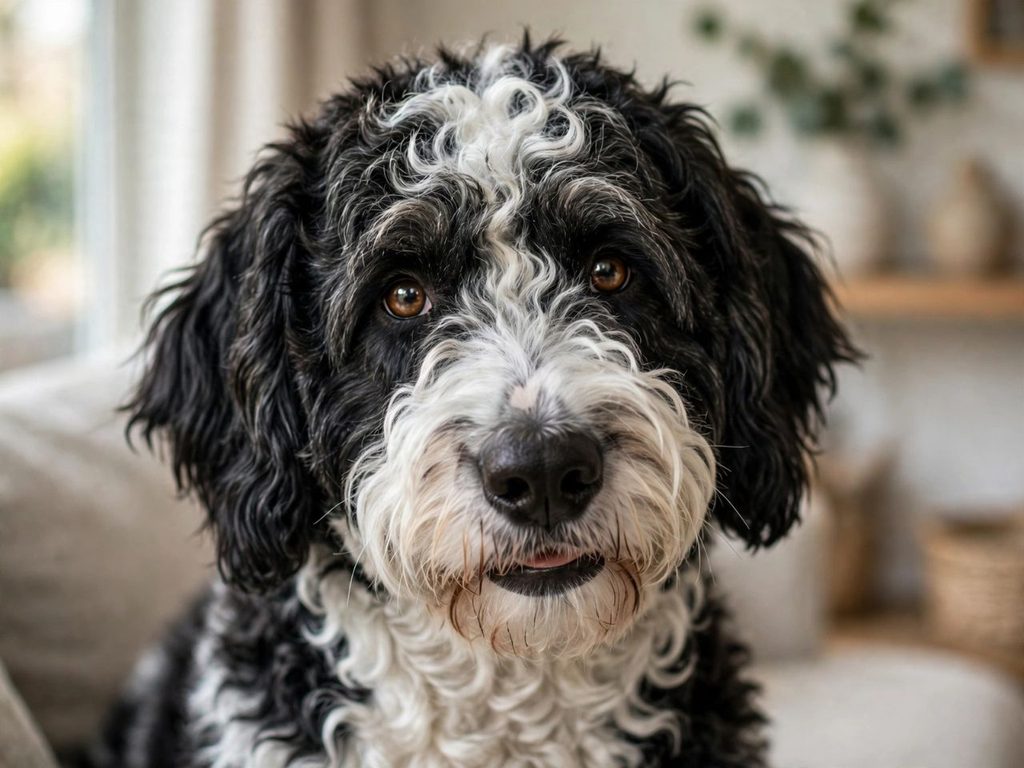
Most Sheepadoodles have a large, fluffy appearance. Their ears usually hang down. Their eyes can disappear beneath long facial hair. Many have a broad dark nose and a thick coat.
Black and white remains one of the most recognizable color combinations. Gray, blue, cream, brown, merle, and tricolor coats can also occur. Coat texture can range from wavy to curly or shaggy.
Color can sometimes prove easier to predict than coat texture or shedding. A puppy with a curly coat may shed less than one with a straighter coat, but no generation label guarantees a specific result.
F1, F1B, and Multigenerational Sheepadoodles
An F1 Sheepadoodle usually comes from an Old English Sheepdog and Poodle pairing. Breeders often describe this generation as roughly half from each parent breed.
An F1B Sheepadoodle usually comes from breeding a Sheepadoodle back to a Poodle. Breeders may select this approach when they want stronger Poodle influence, including a curlier or potentially lower-shedding coat.
A multigenerational Sheepadoodle comes from later-generation Sheepadoodle breeding.
These labels provide useful breeding information, but they do not guarantee coat texture, shedding, allergy response, size, or personality. A responsible breeder’s selection practices and the actual parent dogs remain important.
Sheepadoodle Temperament and Personality
The Sheepadoodle temperament often combines affection, intelligence, playfulness, athleticism, and a strong attachment to people. Many are described as friendly, gentle, outgoing, goofy, and family-oriented.
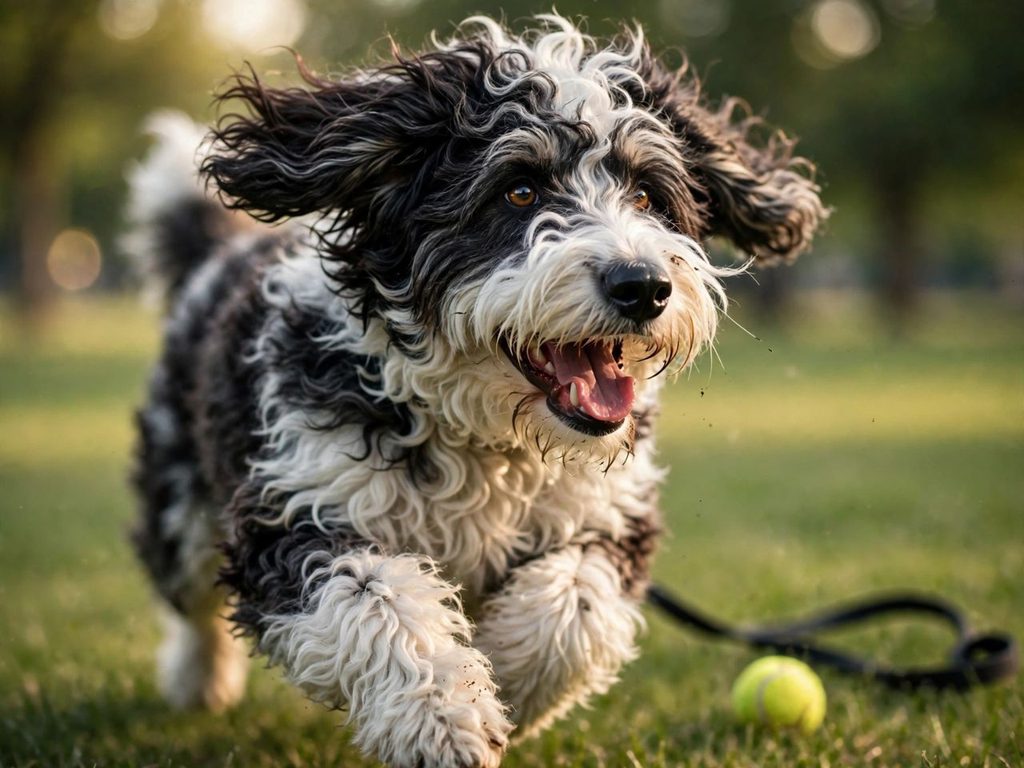
Both parent breeds have working backgrounds. That means a Sheepadoodle may want something to do. A short walk alone may not satisfy an energetic dog. Training games, obedience exercises, scent activities, swimming, retrieving, and other structured activities can provide useful mental work.
Some Sheepadoodles also show independent thinking. Poodles often respond readily to training, while Old English Sheepdogs can bring a more independent streak. Positive reinforcement can make training more engaging and productive.
Are Sheepadoodles Good With Children?
A properly socialized Sheepadoodle can become a good family companion. However, large dogs can accidentally knock over toddlers or small children during excited play.
Supervise interactions with young children. Teach the dog not to chase, circle, jump on, or herd children. Teach children to respect the dog’s food, resting space, toys, and body language.
Herding behavior can appear as staring, circling, blocking movement, chasing, or heel nipping. Redirect those behaviors early instead of allowing them to become habits.
Sheepadoodles With Cats and Other Dogs
Many Sheepadoodles can live successfully with cats and other dogs when owners introduce them carefully. Early socialization can help a puppy learn appropriate interactions.
Still, a Sheepadoodle may chase a running cat or attempt to control another pet’s movement. Use gradual introductions and reward calm behavior. Keep early interactions supervised.
Sheepadoodle Training and Socialization
Training should start early and continue throughout the dog’s life. An intelligent Sheepadoodle can learn commands quickly, but intelligence does not remove the need for consistency.
Use rewards, praise, toys, and short training sessions. Keep lessons active. Repetitive drills can become boring for an energetic dog.
Focus on:
Name recognition
Recall
Loose-leash walking
Sit, stay, and down
Leave-it and drop-it
Calm greetings
Crate training
Grooming cooperation
Door manners
Window-barking control
Appropriate play
Alone-time training
Socialization should expose a puppy gradually to people, dogs, cats, household sounds, cars, different surfaces, grooming tools, veterinary handling, crates, and short periods alone. The goal is not to overwhelm the puppy. The goal is to create positive, controlled experiences.
Separation-related behavior also deserves early attention. Sheepadoodles can become strongly attached to their families. Gradual alone-time training, enrichment, exercise, and predictable routines can help them learn to settle without constant human company.
Sheepadoodle Exercise Needs
Most Sheepadoodles need daily physical activity and mental stimulation. Competitor estimates commonly fall around 45 to 60 minutes or approximately one hour per day, although individual needs vary. A young, energetic Standard Sheepadoodle may need more structured activity than a calmer adult.
Good activities include:
Long walks
Hiking
Swimming
Fetch
Obedience practice
Trick training
Agility
Puzzle toys
Scent games
Frisbee
Controlled play
Do not treat exercise as a race to exhaust the dog. Puppies need age-appropriate activity. Avoid forcing young dogs into repetitive, high-impact running before their skeletons mature.
Watch the dog’s body condition and behavior. A dog that becomes destructive, excessively vocal, restless, or difficult to settle may need more appropriate enrichment.
A secure yard can help, but a yard does not replace interaction. A Sheepadoodle can still become bored in a large yard if nobody engages with it.
Sheepadoodle Grooming and Coat Care
Sheepadoodle grooming represents one of the biggest ownership commitments. Their coats can become dense and tangled. Wavy and curly coats can trap loose hair and form mats.
Many Sheepadoodles need brushing several times each week. Some coats require daily attention. Professional grooming commonly occurs every six to eight weeks.
Do not simply brush the surface. Use thorough line brushing so you can reach the skin. Follow with a metal comb when appropriate. Pay particular attention to:
Behind the ears
Armpits
Collar area
Legs
Tail
Chest
Belly
Between the toes
Mats can pull on the skin and cause discomfort. Severe matting may require professional removal or clipping.
Start grooming training while the puppy is young. Touch the paws. Handle the ears. Lift the lips. Introduce brushes slowly. Reward calm behavior.
Regular care should also include nail trimming, dental care, ear checks, and inspection around the eyes. Floppy ears can retain moisture and debris, especially after swimming.
Do Sheepadoodles Shed and Are They Hypoallergenic?
Sheepadoodles may shed less than many traditional double-coated dogs, but they are not guaranteed to be non-shedding.
The reason is simple. Poodles generally shed very little, while Old English Sheepdogs shed. Their offspring can inherit different coat characteristics. Some Sheepadoodles may shed noticeably. Others may shed very little.
A Sheepadoodle also cannot guarantee an allergy-free home. Dog allergies involve proteins found in substances such as dander, saliva, and other materials, not simply visible hair.
If allergies matter to your household, spend time around the specific dog before making a long-term commitment. Do not rely on a breeder’s “hypoallergenic” label alone.
Sheepadoodle Health and Lifespan
Most competitor sources place the Sheepadoodle lifespan around 12 to 15 years. One lower-authority source reported a shorter range, but that figure conflicts with the more common estimate and should not be treated as the standard expectation.
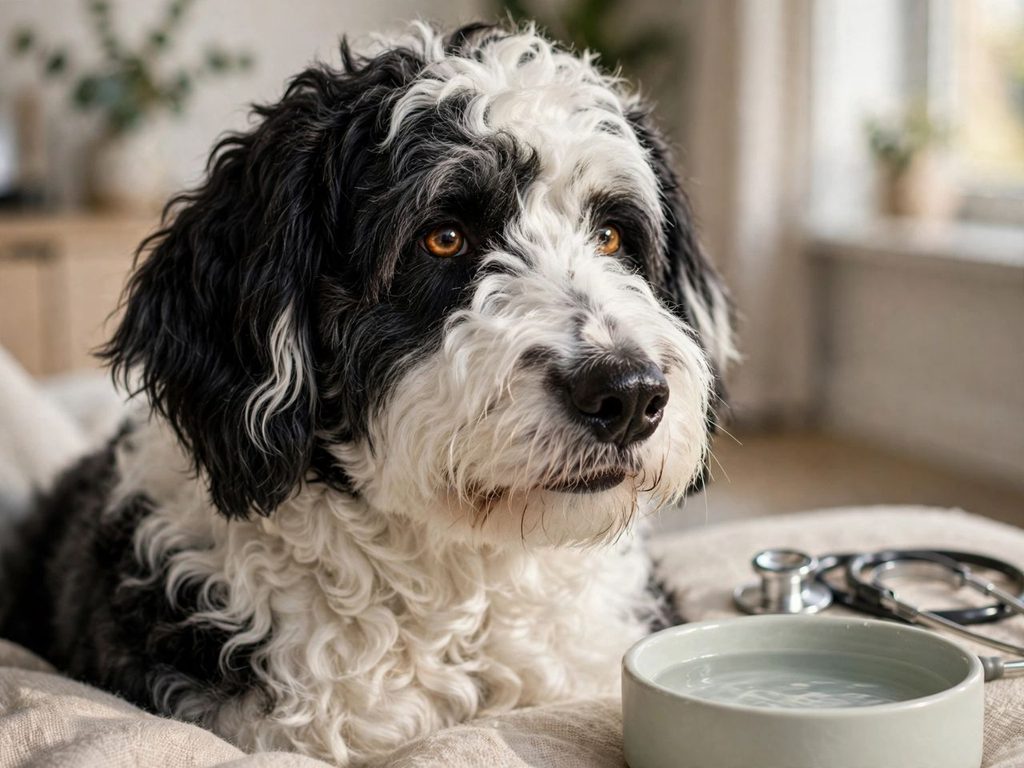
A mixed breed can still inherit conditions associated with either parent breed. Health testing can reduce risk in breeding programs, but it cannot guarantee a perfectly healthy puppy.
Commonly discussed Sheepadoodle health concerns include:
Hip dysplasia
Elbow dysplasia
Bloat and GDV
Progressive retinal atrophy
Cataracts
Corneal dystrophy
Distichiasis
Micropapilla
Addison’s disease
Hypothyroidism
Autoimmune thyroiditis
Sebaceous adenitis
Ear infections
Skin problems
Hip Dysplasia
Hip dysplasia occurs when the hip joint develops abnormally. The condition can contribute to pain, stiffness, arthritis, and reduced mobility.
Both parent breeds can experience hip problems. Weight management, appropriate exercise, veterinary monitoring, and responsible breeding all matter.
Bloat and GDV
Bloat deserves special attention in larger dogs. Gastric dilatation-volvulus, or GDV, occurs when the stomach expands and may twist. The condition can become life-threatening.
Warning signs can include:
Repeated dry heaving
A swollen abdomen
Restlessness
Pacing
Heavy panting
Excessive drooling
Sudden weakness or collapse
Suspected GDV requires immediate veterinary attention. It is an emergency, not a condition to monitor at home.
What to Feed a Sheepadoodle
Choose food according to the dog’s age, size, activity level, and body condition. Large-breed puppies need carefully controlled growth, so competitors recommend nutritionally complete large-breed puppy food for appropriate puppies.
Look for food that meets recognized nutritional standards, and discuss the diet with your veterinarian.
Puppies may eat three or four meals a day initially. Adults commonly transition to two meals daily. Portion size should follow the food’s feeding guide as a starting point, then change according to body condition and veterinary advice.
Treats count toward daily calories. Keeping treats around 10% of daily calories is one commonly cited guideline.
For dogs with GDV concerns, discuss feeding practices with your veterinarian. Common recommendations in the researched material include smaller meals, slowing rapid eating, avoiding raised bowls, reducing mealtime stress, and limiting intense activity around meals.
Do not add joint supplements automatically. Ingredients such as glucosamine, chondroitin, MSM, and omega-3 fatty acids appear in competitor discussions, but supplementation should follow veterinary guidance.
Is a Sheepadoodle Good for Apartment Living?
A Sheepadoodle does not automatically need a huge house. Both Standard and Mini Sheepadoodles may adapt to apartment life when owners provide adequate exercise, enrichment, training, and companionship.
However, apartment living can become difficult if the dog barks at people outside the window or struggles when left alone.
A suitable home should provide:
Reliable daily exercise
Safe outdoor access
Mental enrichment
Barking management
Enough room for the dog’s size
Time for grooming
A plan for alone-time training
A fenced yard can make exercise easier, especially for a Standard Sheepadoodle, but it remains a convenience rather than a substitute for daily interaction.
Sheepadoodles in Hot and Cold Weather
The thick Sheepadoodle coat can create heat-management challenges. Owners in warm climates should provide access to a cool indoor space and fresh water.
Schedule exercise during cooler parts of the day. Avoid hot pavement. Watch for signs of overheating. Regular coat maintenance also matters.
Do not assume that shaving the coat completely provides the best solution. Discuss coat length and clipping with a qualified groomer or veterinarian based on the individual dog’s coat and environment.
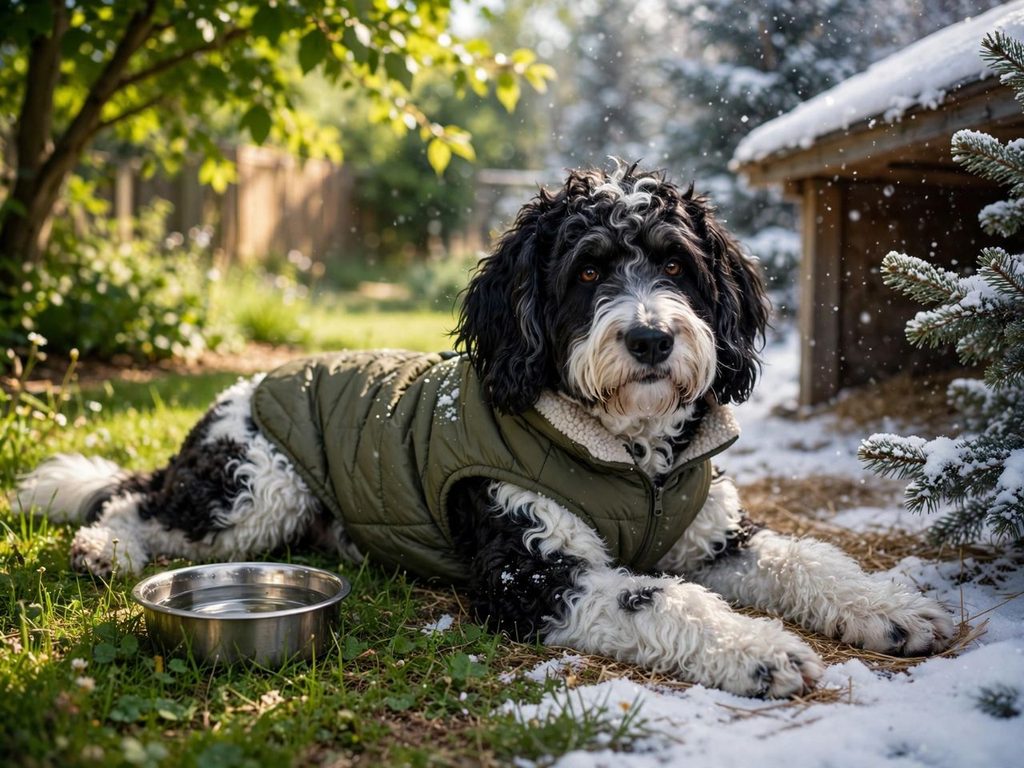
Their dense coats can offer useful protection in colder weather, but winter still requires attention to damp fur, snow, ice, paws, and matting.
How Much Does a Sheepadoodle Cost?
Sheepadoodle puppy prices vary widely. The competitor research reports U.S. prices ranging from roughly $1,300 to $4,500, with some Mini, F1B, rare-color, or premium programs reaching $5,000 or more.
Price can reflect:
Health testing
Breeder experience
Parent dogs
Generation
Size
Location
Coat color
Breeding program
Veterinary care
Puppy raising practices
Do not judge a breeder by price alone. A cheap puppy can become expensive if the breeding program neglects health screening or early care.
Professional grooming also creates a recurring expense. Research in the supplied material commonly places grooming around $80 to $150 per appointment, with several appointments each year.
Budget for food, routine veterinary care, vaccinations, parasite prevention, grooming, training, supplies, insurance, boarding or dog walking, and unexpected medical treatment.
A responsible Sheepadoodle breeder should discuss health openly. Ask to see documented testing for the parent dogs rather than accepting verbal assurances.
The research identifies screening areas that can include:
Hip evaluation
Elbow evaluation
Eye certification
PRA-prcd testing
Thyroid screening
Cardiac evaluation
Other tests relevant to the specific breeding lines
OFA and PennHIP appear repeatedly in the supplied research for orthopedic evaluation, while CAER eye certification and PRA-prcd testing appear in discussions of eye health.
Ask the breeder:
Can I see the parents’ registered health-test results?
Which health problems have appeared in your lines?
Why did you choose these specific tests?
Can I meet the mother?
Can I see previous adult offspring when possible?
What does the health guarantee cover?
What does the puppy contract require?
How do you socialize puppies?
When do puppies go to their new homes?
Be cautious when a breeder focuses heavily on rare colors, blue eyes, deposits, or guaranteed hypoallergenic coats while providing little health documentation.
Sheepadoodle Adoption and Rescue
Buying a puppy is not the only way to find a Sheepadoodle. Adoption can also be worth exploring.
Look at organizations that work with:
Doodle mixes
Poodles
Old English Sheepdogs
Mixed-breed dogs
An adult Sheepadoodle can offer information that a puppy cannot. You can often see the dog’s approximate adult size, coat type, energy level, grooming tolerance, and established behavior.
Ask about separation-related behavior before adoption. Introduce an adult rescue carefully to children, cats, and other dogs. Give the dog time to adjust to a new environment.
Sheepadoodle vs. Other Doodle Mixes
Sheepadoodles share several traits with other popular Poodle mixes. Goldendoodles, Bernedoodles, and Labradoodles can also combine Poodle intelligence and a potentially lower-shedding coat with traits from another breed.
The key differences come from the non-Poodle parent.
A Sheepadoodle brings Old English Sheepdog ancestry. That can mean herding instincts, substantial size, a thick coat, and a strong family attachment. The resulting dog can differ considerably from an individual Goldendoodle, Bernedoodle, or Labradoodle.
Instead of choosing by appearance alone, compare the traits that affect your daily routine:
Adult size
Grooming commitment
Exercise needs
Barking
Herding behavior
Heat tolerance
Time alone
Health risks
Training needs
Is a Sheepadoodle Right for Your Lifestyle?
Before choosing a Sheepadoodle, look beyond the fluffy appearance.
Consider whether you can provide daily exercise and mental stimulation. Think about the grooming commitment. A coat that looks beautiful in photographs can require significant maintenance.
Also consider your tolerance for barking, your schedule, your living space, and your ability to manage a large, energetic dog.
A Sheepadoodle can be a loving companion for an active household that understands these responsibilities. But the individual dog matters. Genetics, socialization, training, breeding, health, and environment all shape the experience.
Frequently Asked Questions
What is a Sheepadoodle?
A Sheepadoodle is a mixed-breed cross between an Old English Sheepdog and a Poodle.
How big does a Sheepadoodle get?
A Standard Sheepadoodle commonly weighs about 65–85 pounds and stands around 16–22 inches tall.
Are Sheepadoodles hypoallergenic?
No, Sheepadoodles are not guaranteed to be hypoallergenic or completely allergen-free.
How long do Sheepadoodles live?
Most competitor sources report an average Sheepadoodle lifespan of about 12–15 years.
Do Sheepadoodles need a lot of grooming?
Yes, many Sheepadoodles need frequent brushing and professional grooming about every six to eight weeks.
Conclusion
A Sheepadoodle can combine intelligence, affection, playfulness, and a strong family bond in one striking companion. But the breed’s fluffy appearance should not hide its real responsibilities. Size, coat, shedding, temperament, and health can vary because the
Sheepadoodle has no fixed breed standard. Plan for regular grooming, daily exercise, lifelong training, careful nutrition, veterinary care, and possible inherited health problems. If you choose a puppy, verify the parents’ health testing and look beyond color or appearance. If you consider adoption, an adult dog can give you a clearer picture of its size, coat, and behavior before you commit.
I’m a passionate pet writer who loves sharing practical tips, trusted advice, and heartwarming stories about cats, dogs, and other beloved companions. Through PetCaffine.com, I help pet lovers better understand their furry friends with easy-to-read articles on pet care, nutrition, behavior, health, and everyday life.





1 thought on “Sheepadoodle: Size, Temperament, Care, Health & Cost”