LWK Meaning: What It Means in Texting, TikTok, and Social Media
You saw “lwk” in a text or a TikTok caption. You paused, because it didn’t look like a normal word. Don’t worry — it’s simple slang, not a mystery code. Most people use it to soften a feeling or opinion. This guide explains exactly what it means, how to use it, and when to skip it.
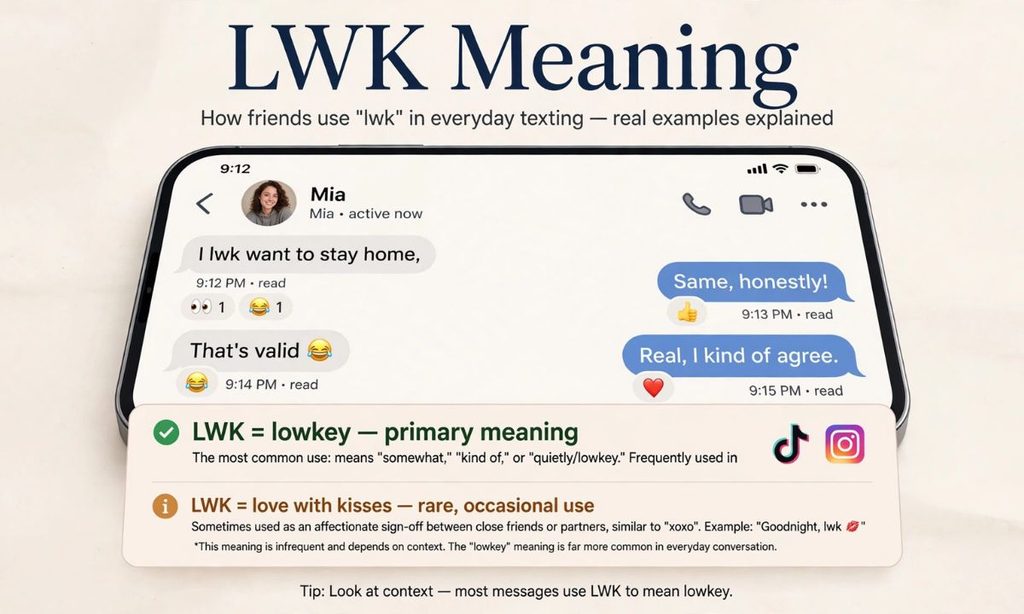
LWK is short for “lowkey” (sometimes written “low-key”). It’s used to soften a statement, making it sound casual, subtle, or understated rather than dramatic or intense.
Think of it as a verbal shrug attached to a sentence. It lets someone admit a feeling, opinion, or preference without making it sound like a big deal.
Example:
“I lwk want pizza right now.” → “I kind of want pizza right now.”
That’s the meaning you should assume by default, in almost every text, comment, or caption you see it in.
Is LWK an Acronym or Just a Short Form?
Here’s something worth clearing up right away: LWK isn’t a traditional acronym where each letter stands for a separate word. It’s simply a condensed spelling of “lowkey” — the vowels get dropped, the way “text” often becomes “txt” or “you” becomes “u.”
That distinction matters, because if you try to sound it out letter by letter (Low… Word… Key?), you’ll miss the point entirely. It’s a shorthand spelling, not a phrase made from initials.
LWK vs. Lowkey vs. Low-Key: Does Spelling Matter?
You’ll see this word written a few different ways, and they all mean the same thing:
lwk — the texting shorthand
lowkey — the casual, one-word spelling most common in speech and captions
low-key — the more traditional, hyphenated spelling
None of these spellings change the meaning. Casing doesn’t matter either — “LWK,” “Lwk,” and “lwk” are all treated the same in everyday use. Pick whichever version fits your typing style.
What Does “Lowkey” Actually Mean?
Understanding the base word makes the abbreviation much easier to use correctly. “Lowkey” generally works like one of these phrases:
Kind of
Slightly
Secretly
Quietly
I don’t want to make a big deal of this
Examples showing the range of meaning:
“I lwk think she’s right.” → I kind of think she’s right.
“I’m lwk nervous about the interview.” → I’m slightly nervous about the interview.
“I lwk miss my old job.” → I secretly miss my old job.
“Lwk hoping they cancel practice.” → Quietly hoping they cancel practice.
The common thread: the speaker has a genuine thought or feeling, but they’re choosing to express it with reduced intensity.
How LWK Changes the Tone of a Message
LWK doesn’t change what someone means — it changes how strong it sounds. This is the part most people miss.
Compare these two sentences:
“I love this song.” — a direct, confident statement.
“I lwk love this song.” — the same feeling, but delivered more casually, almost like the speaker is downplaying their own enthusiasm.
LWK can also do the following in a conversation:
Soften an opinion so it doesn’t sound too forceful
Signal mild agreement without full commitment
Make a confession feel low-stakes
Add humor through understatement
Take the edge off mild criticism
Example of softened criticism:
“That movie was lwk kind of boring.” — this feels gentler than a flat “that movie was boring.”
How to Use LWK in a Sentence
LWK almost always comes right before the thing being softened — a feeling, opinion, or want.
Common sentence patterns:
Lwk + feeling → “I’m lwk excited for the weekend.”
Lwk + opinion → “That sequel was lwk better than the original.”
Lwk + preference → “I lwk want to stay in tonight.”
Lwk + confession → “I lwk forgot your birthday.”
It can also stand alone as a quick reaction:
“LWK.” (as a one-word comment under a post, meaning “honestly, kind of”)
Punctuation and emoji patterns:
LWK is rarely followed by heavy punctuation. It blends into casual sentences without a comma, though some people add one for emphasis: “I, lwk, don’t want to go.” It often appears alongside emojis like 👀, 😭, or 💀 to reinforce a joking or self-aware tone.
LWK Meaning by Platform
The core meaning of LWK doesn’t change across apps, but the context does. Here’s how it typically shows up:
Platform
Typical Use
Text messages
Softening a feeling or opinion in one-on-one or group chats
TikTok
Captions and comments expressing understated appreciation or relatable humor
Snapchat
Casual chat reactions, sometimes paired with an affectionate sign-off
Instagram
Comments and captions under posts, especially trend-related content
Discord/X
Community chat reactions, often joking or self-deprecating
LWK on TikTok
On TikTok, LWK often shows up in captions or comments to express genuine but restrained appreciation.
Example:
“LWK obsessed with this trend” — means the person genuinely likes it but is downplaying how much, often for comedic effect.
LWK on Snapchat and Instagram
On these platforms, LWK usually functions the same way as in texting — a tone softener. But it can occasionally appear as a sign-off, especially between close friends or partners, where it may hint at a different, less common meaning (more on that below).
Does LWK Ever Mean Something Other Than “Lowkey”?
Yes — but rarely, and you should treat these as exceptions, not the default.
The most notable alternate meaning: “Love With Kisses”
Some people use LWK as an affectionate sign-off, similar to “XOXO,” especially in messages between close friends, family, or romantic partners.
How to tell the difference:
Clue
Likely Meaning
Appears before a feeling, opinion, or want
Lowkey
Appears mid-sentence in casual chat
Lowkey
Appears at the very end of a message, alone
Possibly “Love with kisses”
Sent by a close friend or partner as a goodbye
Possibly “Love with kisses”
Everywhere else
Default to lowkey
Example:
“Goodnight, lwk” from a partner might mean “goodnight, love with kisses.”
“I lwk can’t sleep” clearly means “I kind of can’t sleep.”
Other rare, unverified expansions occasionally show up online, such as “laughing without kidding” or “look who’s kidding.” These are far less common and inconsistently used. If you see LWK in the wild, “lowkey” is almost always the safe, correct interpretation unless strong context points elsewhere.
LWK vs. HK: What’s the Opposite?
If LWK means “lowkey,” the direct opposite is HK, short for “high-key.”
They can overlap in casual use, but LWK specifically dials down the emotional volume of whatever follows it. TBH and NGL are more about honesty framing than intensity.
How to Reply When Someone Uses LWK
You don’t need to match their exact wording. Just respond to the actual content of the message.
A few reply approaches:
If they share a quiet preference: “Same, honestly!”
If they admit a mild feeling: “That’s valid, don’t stress about it.”
And If they state a soft opinion: “Real, I kind of agree.”
If you’re unsure what they mean: simply ask — “Wait, lowkey or lwk as in love with kisses? 😂”
There’s no obligation to reply “LWK” back. Matching the tone is optional, not required.
When You Should Avoid Using LWK
LWK is built for casual conversation, not formal writing. It works well with friends, in DMs, or under social posts. It does not work well in:
Work emails or Slack messages
Client-facing communication
Formal reports or academic writing
Serious or sensitive conversations (conflict, health, consent-related topics)
Why it matters: slang like LWK can create ambiguity in situations that need clarity. If you’re discussing something important — a deadline, a disagreement, or an emotional topic — say exactly what you mean instead of softening it with slang.
Assuming every LWK is an affectionate sign-off — it usually isn’t
Treating rare alternate meanings as equally likely as “lowkey” — they aren’t
Reading LWK as a strong, confident statement — it’s meant to be the opposite
Missing sarcasm or self-aware humor, especially on TikTok
Ignoring the conversation’s tone and relationship context
When in doubt, default to “lowkey,” and only consider an alternate meaning if the context strongly points that way — like an affectionate closing line from someone close to you.
Where Did “Lowkey” Come From?
“Low-key” existed as spoken English long before texting shorthand picked it up. It originally described something subdued, modest, or intentionally not emphasized — a “low-key event,” for example, means a quiet, understated one.
As texting and social media grew, users shortened the spoken phrase into “lowkey,” then further compressed it into “lwk” for faster typing. The tone-softening function carried over directly: just as a “low-key party” is modest and quiet, a “lowkey” statement is a modest, quiet version of a stronger feeling.
Frequently Asked Questions
What does LWK mean in text?
LWK means “lowkey,” used to soften a feeling, opinion, or preference so it sounds more casual.
What does LWK mean on TikTok?
On TikTok, LWK works the same way as in texting — usually expressing genuine but understated appreciation or reaction.
Is LWK the same as lowkey?
Yes, LWK is simply a shortened spelling of “lowkey,” not a separate word or phrase.
What is the opposite of LWK?
The opposite is HK, short for “high-key,” which signals strong, obvious intensity instead of understatement.
Does LWK ever mean “love with kisses”?
Rarely — usually only when it appears alone as a sign-off from a close friend or partner; otherwise, assume “lowkey.”
Conclusion
LWK is one of those small texting terms that says a lot without saying much at all. In almost every case, it simply means “lowkey” — a way to admit a feeling or opinion while keeping things casual and low-pressure.
Save the rare “love with kisses” reading for clear sign-offs between people you’re close with, skip the term entirely in formal writing, and lean on context whenever the meaning feels unclear. Once you get comfortable with that, you’ll never second-guess an LWK text again.
I’m a passionate pet writer who loves sharing practical tips, trusted advice, and heartwarming stories about cats, dogs, and other beloved companions. Through PetCaffine.com, I help pet lovers better understand their furry friends with easy-to-read articles on pet care, nutrition, behavior, health, and everyday life.

2 thoughts on “LWK Meaning: What It Means in Texting, TikTok, and Social Media”