SNM Meaning: What It Means in Texting and Social Media
You just saw “SNM” in a text or a comment, and now you’re stuck guessing. Don’t worry, it’s simple once you know the phrase behind it. Most of the time, it’s a quick way to say “I understand.” But the tone can shift depending on the situation. This guide breaks down exactly what it means, when to use it, and how to reply.
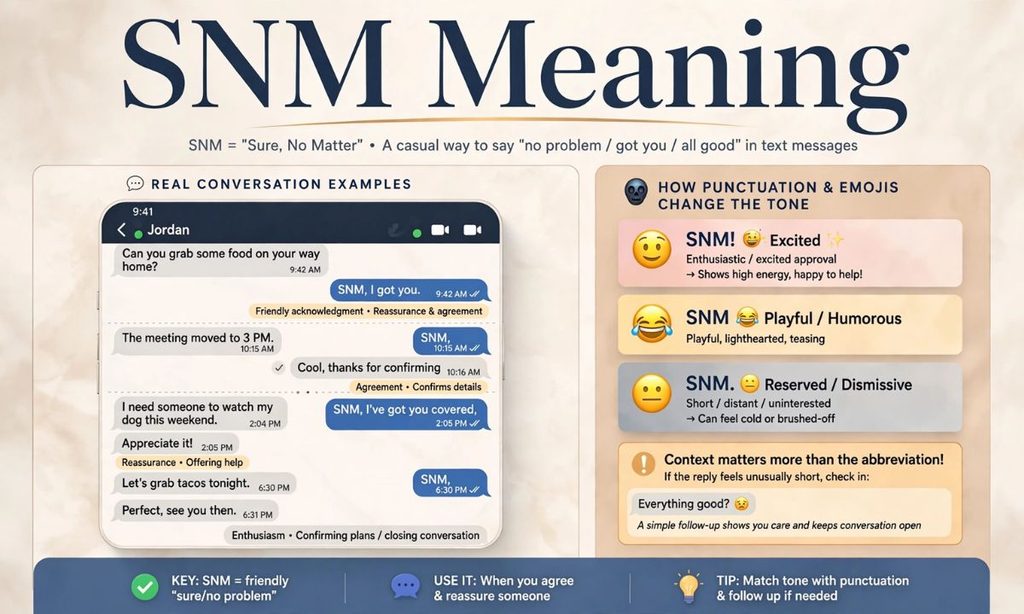
SNM stands for “say no more.” It’s a fast way of telling someone that their message is already clear and doesn’t need further explanation.
Example:
“Can you grab me a coffee on your way in?”
“SNM, I got you.”
In that exchange, SNM works like a confident nod — the sender understood immediately and doesn’t need any more detail. That’s the meaning you should assume by default.
What Does “Say No More” Actually Mean?
“Say no more” is a phrase people have used in spoken English long before texting shortened it. It signals that the listener already gets the point, so continuing to explain would be unnecessary.
In text form, SNM can translate to any of these:
“I understand.”
“I get it.”
“I hear you.”
“No need to explain further.”
“I’m on the same page.”
“Consider it done.”
The common thread across all of these: the recipient is confirming understanding and closing the loop on further explanation.
How SNM Is Used in Everyday Texting
SNM shows up in a handful of common conversational roles. Here’s how each one plays out.
SNM as Simple Acknowledgment
Sometimes SNM is just a quick “got it” — nothing more, nothing less.
Example:
“The meeting moved to 3 PM.”
“SNM.”
SNM as Agreement
SNM can confirm that the sender agrees with a plan, opinion, or suggestion.
Example:
“Let’s grab tacos tonight.”
“SNM, I’m starving anyway.”
SNM as Readiness to Help
It often shows up when someone is agreeing to take care of a task.
Example:
“I need someone to watch my dog this weekend.”
“SNM, I’ve got you covered.”
SNM as Reassurance or Confidentiality
When someone shares something private, SNM can mean “your secret is safe with me.”
Example:
“Please don’t tell anyone about this.”
“SNM. It stays between us.”
SNM as Enthusiasm
Paired with an exclamation point or emoji, SNM can express excitement rather than a flat acknowledgment.
Example:
“Concert tickets go on sale at noon.”
“SNM! I’m setting an alarm right now.”
The Two Sides of SNM: Friendly vs. Dismissive
This is the part people often miss: SNM isn’t always warm and cooperative. Depending on tone and context, it can also mean the opposite of friendly.
Tone
What It Signals
Typical Context
Friendly
“I understand, and I’m happy to help.”
Plans, requests, casual agreement
Neutral
“Got it, message received.”
Everyday factual exchanges
Enthusiastic
“I’m excited and on board.”
Invitations, exciting news
Reassuring
“Your secret is safe.”
Confidential or sensitive information
Dismissive
“That’s enough — stop explaining.”
Repetitive complaints, unwanted details
Sarcastic
An ironic or ambiguous reaction
Gossip, drama, exaggerated stories
How to tell which one you’re dealing with:
A short, standalone “SNM.” with a period, especially after a long message, often signals impatience.
“SNM!” with an exclamation point usually signals enthusiasm.
“SNM 😂” or “SNM 💀” usually signals humor or disbelief.
“SNM, I got you” or “SNM, consider it done” signals clear cooperation.
Reading the punctuation and the message right before SNM tells you almost everything you need to know about the sender’s intent.
SNM vs. “Say Less”
These two phrases overlap, but they aren’t identical.
SNM (“say no more”) usually signals that explanation is no longer needed — the point has landed.
“Say less” carries a similar meaning but often leans more toward enthusiasm or immediate willingness to act, almost like “I’m already in.”
Example comparison:
“Can you help me move this weekend?”
“SNM.” (a calm, simple acknowledgment)
“Say less.” (a more eager, energetic agreement)
Both work in casual conversation, but “say less” tends to sound a little more upbeat and immediate.
How SNM Is Used Across Platforms
The meaning of SNM stays consistent everywhere, but the context shifts slightly by platform.
Texting: The most common home for SNM — used in one-on-one and group chats to confirm understanding or agreement.
Snapchat: Frequently appears in short chat replies, often paired with emojis to soften or clarify tone.
TikTok: Shows up in comments and captions, usually reacting to a relatable video or confirming agreement with a creator’s point.
Instagram: Common in comments and DMs, especially under trend-based posts or emotional captions.
X (Twitter) and Discord: Used in quick replies within threads or community chats, often with a more casual, joking tone.
Example on TikTok:
Comment under a relatable video: “SNM, this is literally me every Monday.”
Example on Snapchat:
“Wanna skip the party and just get food instead?”
“SNM 😩 I’m tired anyway.”
How to Reply to SNM
You don’t need to answer with slang of your own — just respond naturally to what SNM implied.
A few solid reply options:
If it confirmed agreement: “Perfect, see you then.”
If it confirmed understanding: “Cool, thanks for confirming.”
If it sounded cooperative: “Appreciate it!”
If it sounded short or off: try changing the subject, or ask an open question like “Everything good?”
When SNM ends a conversation abruptly:
If someone replies with a flat “SNM.” and stops responding, they might simply be busy — or they might be signaling they’re done with the topic. Don’t overanalyze a single short reply; look at the overall pattern of the conversation instead.
SNM works well in casual texting, but it doesn’t belong everywhere. Skip it in:
Professional emails
Workplace messaging with clients or supervisors
Legal, medical, or official communication
Any conversation where a misunderstanding could cause real problems
Why this matters: SNM is compact, but that compactness creates ambiguity. In a low-stakes chat with a friend, that’s fine. In a professional setting, a misread tone can create confusion or come across as curt.
Clearer alternatives for formal contexts:
“Understood, thank you for the clarification.”
“I’ll take care of that — no further details needed.”
“Got it, I’ll proceed as discussed.”
Does SNM Ever Mean Something Else?
Yes — but these alternate meanings are far less common, and you should only consider them when context clearly points that way.
Alternate Meaning
Typical Context
Special nuclear material
Regulatory, scientific, or technical writing
Sacred Name Movement
Religious discussion
Sant Nirankari Mission
Religious/spiritual organization
Show no mercy
Gaming, motivational, or competitive contexts
Smoke and mirrors
Figurative or pop-culture references
So not me
Casual social-media disagreement
SNOM (cryptocurrency ticker)
Finance and crypto discussions
A couple of rare, informal expansions (“sucks for me,” or a more explicit and confrontational phrase used in some slang communities) occasionally appear online. These are inconsistent, community-specific, and sometimes offensive. Don’t assume them without strong contextual evidence — in nearly every ordinary text or comment, “say no more” is the correct reading.
How to Identify the Correct Meaning of SNM
When you’re not sure what someone meant, run through this quick checklist:
What was the message right before SNM? A request, a secret, a joke, or a complaint all point toward different tones.
Is there punctuation or an emoji attached? An exclamation mark suggests enthusiasm; a lone period can suggest a closed conversation.
What’s your relationship with the sender? A close friend’s SNM usually reads warmer than a stranger’s.
What platform is this on? TikTok comments tend to be playful; workplace chats tend to be literal.
Is the topic technical or specialized? If you’re in a scientific, religious, or financial conversation, a rare alternate meaning might actually apply.
If you’re still unsure, it’s always fine to just ask directly.
SNM vs. Similar Texting Abbreviations
SNM sits alongside a handful of other short acknowledgment phrases. Here’s how they compare:
SNM (“say no more”) — confirms understanding, may also express agreement or closure
IKR (“I know, right?”) — expresses shared agreement or relatability
NVM (“never mind”) — withdraws or cancels a previous statement
TTYL (“talk to you later”) — signals the end of a conversation, without ambiguity
Copy that / Got it — plain, unambiguous acknowledgment with no tonal guesswork
If you want to avoid any risk of being misread, phrases like “got it” or “understood” carry less ambiguity than SNM — though they also carry less personality.
Where Did SNM Come From?
The spoken phrase “say no more” has been part of everyday English for a long time, used to tell someone their point has already landed. As texting culture grew, users shortened common phrases into acronyms for speed — SNM became the natural compression of that phrase, following the same pattern as other texting shorthand.
The exact date it entered widespread internet use isn’t well documented, and claims about a specific decade should be treated as estimates rather than verified history. What’s clear is that as messaging apps, comment sections, and DMs became the primary place people communicate casually, short acknowledgment phrases like SNM spread quickly because they save time without losing meaning.
Common Mistakes When Interpreting SNM
Avoid these misreadings:
Assuming SNM always means friendly agreement — it can also mean “stop explaining”
Ignoring punctuation, which often carries the real tone
Treating rare technical meanings as common in casual chat
Using SNM in professional or sensitive communication where clarity matters more than brevity
Confusing SNM with unrelated abbreviations like SNN or SN
When in doubt, default to “say no more,” and let the surrounding conversation guide any exceptions.
Frequently Asked Questions
What does SNM mean in text?
SNM means “say no more” — it signals that the recipient already understands and doesn’t need further explanation.
Does SNM mean “I agree”?
Yes, it often confirms agreement or acceptance of a plan, in addition to simple understanding.
Can SNM sound rude or dismissive?
Yes — a short “SNM.” after a long or repeated explanation can signal impatience or a wish to stop discussing the topic.
Is SNM the same as “say less”?
They’re similar, but “say less” usually carries a more enthusiastic, immediate tone than the calmer “SNM.”
Is SNM appropriate to use at work?
Generally no — it’s best kept in casual texting and social media, since formal settings benefit from clearer, unambiguous language.
Conclusion
SNM is a small piece of texting shorthand that carries a surprising amount of nuance. In almost every case, it simply means “say no more” — a quick way to confirm understanding, agreement, or readiness to help. The real skill is reading the tone around it: a period can feel dismissive, an exclamation point can feel excited, and an emoji can turn a flat acknowledgment into a warm one. Once you get comfortable reading those small signals, you’ll never second-guess an SNM text again.
I’m a passionate pet writer who loves sharing practical tips, trusted advice, and heartwarming stories about cats, dogs, and other beloved companions. Through PetCaffine.com, I help pet lovers better understand their furry friends with easy-to-read articles on pet care, nutrition, behavior, health, and everyday life.




2 thoughts on “SNM Meaning: What It Means in Texting and Social Media”