What Time Was It 5 Hours Ago? A Simple Way to Find Out
Quick question: do you know exactly what time it was five hours before right now? Most people pause, count on their fingers, and still get it wrong once midnight gets involved. The math is simple once you know the trick. Here’s exactly how to calculate it, every time, without guessing.
“5 hours ago” means the clock time that occurred exactly five hours before your current reference point.
If it’s 3:00 PM right now, five hours ago was 10:00 AM. That part is easy. Things only get tricky when the subtraction crosses midnight, because then the date changes too, not just the hour.
Two numbers matter here, and it helps to know them upfront:
5 hours = 300 minutes
5 hours = 18,000 seconds
Keep those in mind. They come in handy for both manual math and understanding how time calculators work behind the scenes.
Why the Answer Depends on Your Current Time
There’s no single fixed answer to “what time was it 5 hours ago.” The result only makes sense once you know your starting point.
That starting point depends on three things:
The current time you’re calculating from
The time zone you’re in (or the one you care about)
The clock format you’re using, 12-hour or 24-hour
A calculator that just says “5 hours ago was X” is really doing one thing: taking your device’s current time and subtracting five hours from it. If your device clock is wrong, or set to the wrong time zone, the answer will be wrong too. So the first step, always, is confirming your actual current time before you subtract anything.
The Basic Rule: Subtract Five Hours
Here’s the core method in plain terms:
Start with the current hour.
Subtract 5.
If the result drops to zero or below, wrap around using 12 (for 12-hour clocks) or 24 (for 24-hour clocks).
Adjust AM/PM if you crossed noon or midnight.
Check whether the date needs to move back a day.
That’s it. Steps 3 through 5 are where most people slip up, so let’s walk through each clock format separately.
How to Calculate 5 Hours Ago on a 12-Hour Clock
On a 12-hour clock, the minutes always stay the same. Only the hour changes, and sometimes AM/PM flips too.
Here’s the rule: subtract 5 from the hour. If the number drops below 1, add 12 and switch AM/PM.
Current Time
5 Hours Ago
3:00 PM
10:00 AM
9:00 AM
4:00 AM
1:00 PM
8:00 AM
7:45 PM
2:45 PM
2:00 AM
9:00 PM (previous day)
12:30 AM
7:30 PM (previous day)
Notice the last two rows. Whenever your current time is earlier than 5:00 AM, subtracting five hours pushes you into the previous evening, and the calendar date rolls back by one.
The 24-hour clock (also called military time) skips AM/PM entirely, which removes one whole layer of confusion.
The rule: subtract 5 from the hour. If the result is negative, add 24 and move to the previous day.
Current Time (24-hr)
5 Hours Ago
15:00
10:00
07:00
02:00
20:15
15:15
03:00
22:00 (previous day)
00:30
19:30 (previous day)
This is why pilots, the military, and most international schedules default to 24-hour time. There’s no AM/PM label to misread, so fewer mistakes creep in.
Calculating 5 Hours Ago Using Total Minutes
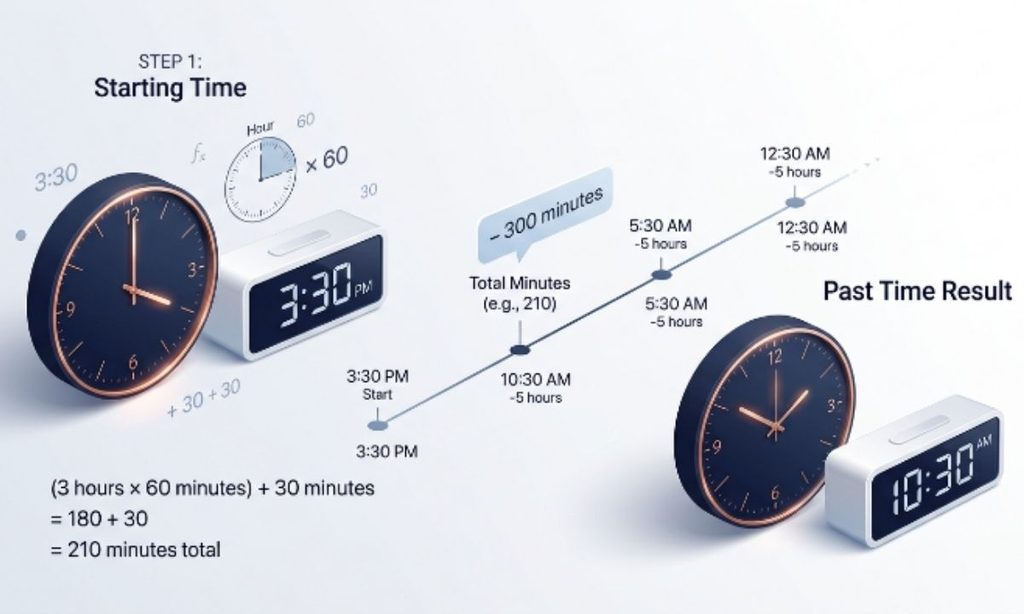
If your current time includes minutes and you want a foolproof method, convert everything into total minutes first. This removes any chance of hour/minute mix-ups.
The formula:
Convert the current time to 24-hour format.
Multiply the hour by 60, then add the minutes.
Subtract 300 (that’s 5 hours in minutes).
If the result is negative, add 1,440 (minutes in a full day) and mark the date as the previous day.
Convert the total back into hours and minutes.
Worked example:
Say it’s 2:20 PM.
Convert to 24-hour time: 14:20
Multiply: 14 × 60 = 840, plus 20 minutes = 860 total minutes
So five hours before 2:20 PM was 9:20 AM. This method works no matter how odd the minutes are, which makes it the most reliable option for manual math.
Does the Date Change When You Subtract 5 Hours?
Yes, sometimes it does, and this is the single most common mistake people make.
Here’s the simple rule for figuring out when:
If your current time is between 12:00 AM and 4:59 AM, subtracting five hours lands you in the previous calendar day.
If your current time is 5:00 AM or later, the result stays on the same calendar day.
A few concrete examples to lock this in:
12:10 AM → 7:10 PM the previous day
4:45 AM → 11:45 PM the previous day
5:00 AM → 12:00 AM, same date (exactly midnight)
5:01 AM → 12:01 AM, same date
That 5:00 AM cutoff is the tipping point. Anything before it rolls the date back; anything at or after it doesn’t.
Five Hours in Other Units
Sometimes you need the duration itself, not just the resulting clock time. Here’s the full breakdown:
Unit
Value for 5 Hours
Minutes
300
Seconds
18,000
Milliseconds
18,000,000
These numbers are useful for programming, timestamp math, log file analysis, or any situation where you’re working with raw time values instead of a clock face.
Time Zones Can Change Everything
If you’re calculating “5 hours ago” for a different location than your own, time zones add another layer to think about.
A few things worth knowing:
There are 24 standard time zones around the world, each generally offset from UTC by a whole number of hours.
Some regions use unusual half-hour or 45-minute offsets. India and Nepal are well-known examples.
Daylight saving time can shift a region’s clock by an additional hour during part of the year.
Before subtracting five hours for a different city or country, always confirm whether you’re working in local time or UTC. Mixing the two is one of the fastest ways to get a wrong answer, especially for flights, international calls, or comparing timestamps across regions.
Common Mistakes to Avoid
A few small errors account for almost every wrong answer people get when doing this calculation by hand.
Forgetting the date rollover. If your starting time is before 5:00 AM, the date needs to move back a day too.
Mixing up AM and PM. This happens most often when the subtraction crosses the 12:00 mark.
Accidentally changing the minutes. When subtracting a clean 5-hour block, minutes should stay exactly the same.
Using the wrong time zone. Always confirm whether you’re working with local time or UTC before doing the math.
Skipping verification. For anything important, run the same calculation a second way, or check it against an online calculator.
Real-Life Situations Where This Calculation Matters
This isn’t just a trivia question. People need this kind of reverse time math constantly.
Medication schedules: Figuring out when a dose was taken, based on how many hours have passed.
Work shifts. Confirming what time a shift started if it’s been running for five hours.
Flights and travel: Reconstructing boarding, departure, or layover times for expense reports or planning.
Memory and recall: Anchoring a fuzzy memory (“it happened around lunch”) to an actual clock time.
Timestamps and logs: Reading server logs, chat histories, or social media posts that show relative time instead of a fixed clock time.
In most of these cases, getting the date rollover wrong is the part that causes real problems, especially for anything time-stamped or scheduled.
A Quick Reference Table for Every Hour
Here’s a full-day cheat sheet so you don’t have to redo the math each time.
Current Time
5 Hours Ago
12:00 AM
7:00 PM (previous day)
2:00 AM
9:00 PM (previous day)
4:00 AM
11:00 PM (previous day)
5:00 AM
12:00 AM (same day)
7:00 AM
2:00 AM
9:00 AM
4:00 AM
11:00 AM
6:00 AM
1:00 PM
8:00 AM
3:00 PM
10:00 AM
5:00 PM
12:00 PM
7:00 PM
2:00 PM
9:00 PM
4:00 PM
11:00 PM
6:00 PM
Bookmark this table if you find yourself doing this kind of calculation often.
Frequently Asked Questions
How many minutes are in 5 hours?
There are 300 minutes in 5 hours.
Does the date change when calculating 5 hours ago?
Yes, if the current time is before 5:00 AM, five hours ago falls on the previous calendar day.
What is 5 hours before 12 AM?
Five hours before 12:00 AM is 7:00 PM the previous day.
How do I calculate 5 hours ago on a 24-hour clock?
Subtract 5 from the current hour, and if the result is negative, add 24 and move to the previous day.
Does daylight saving time affect this calculation?
Yes, on the specific days a region shifts its clocks, the usual five-hour subtraction can land on a time that either repeats or skips due to the one-hour change.
Conclusion
Figuring out what time it was five hours ago comes down to one simple habit: subtract five from the hour, keep the minutes the same, and always double-check whether the date needs to roll back. Once you know the 5:00 AM cutoff and keep 12-hour and 24-hour math straight, you’ll never have to second-guess this calculation again.
I’m a passionate pet writer who loves sharing practical tips, trusted advice, and heartwarming stories about cats, dogs, and other beloved companions. Through PetCaffine.com, I help pet lovers better understand their furry friends with easy-to-read articles on pet care, nutrition, behavior, health, and everyday life.





2 thoughts on “What Time Was It 5 Hours Ago? A Simple Way to Find Out”