How Long Until 1:00 PM? Time Calculator and Easy Guide
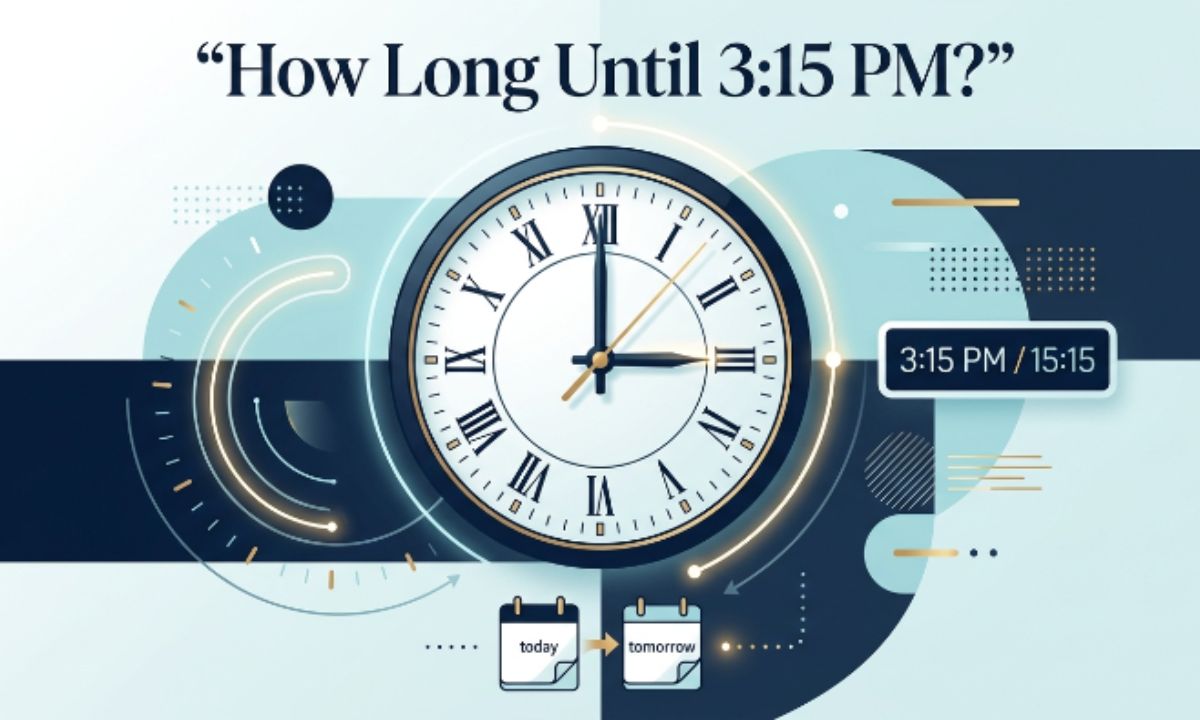
You want to know how long until 1:00 PM. The answer depends on your clock right now. Subtract the current time from 1:00 PM, or 13:00 in 24-hour time. If 1:00 PM has already passed, count toward tomorrow. This guide shows you the fast method, plenty of examples, and tips to use the time well.
Find your current time in the table. Read the time left.
Current time
Time until 1:00 PM
Total minutes
6:00 AM
7 hours
420
7:00 AM
6 hours
360
8:00 AM
5 hours
300
9:00 AM
4 hours
240
10:00 AM
3 hours
180
11:00 AM
2 hours
120
11:30 AM
1 hour 30 minutes
90
12:00 PM
1 hour
60
12:30 PM
30 minutes
30
12:45 PM
15 minutes
15
Every hour you move closer removes one hour from the total. You can estimate the answer at a glance once you see this pattern.
How Many Hours Until 1 PM?
Subtract your current hour from 1 PM. If it is morning, the math is simple. If it is after 1 PM, you need to wrap around to tomorrow.
Example: it is 9:00 AM. Count from 9 to 1 PM. That is 4 hours.
Example: it is 11:00 AM. Count from 11 to 1 PM. That is 2 hours.
A handy trick: go to noon first, then add one. From 9:00 AM to noon is 3 hours. Add 1 more hour for 1 PM. The total is 4 hours.
How Many Minutes Until 1 PM?
Multiply the hours left by 60. Then add any extra minutes.
Example: you have 2 hours and 15 minutes left. Multiply 2 by 60 to get 120. Add 15. The total is 135 minutes.
Seconds follow the same logic. Multiply the minutes by 60. So 135 minutes equals 8,100 seconds.
Minutes help when a short deadline looms. At 12:40 PM, you have 20 minutes. That is enough time for one quick task, but not two.
What Is 1:00 PM in 24-Hour Time?
1:00 PM equals 13:00 in 24-hour time. People write it as 1300 in military style and say “thirteen hundred hours.”
The rule is simple. For any PM hour from 1 to 11, add 12. So 1 PM becomes 13.
To go back, subtract 12. The hour 13 becomes 1, and you add PM.
1:00 PM also equals 780 minutes after midnight. Multiply 13 hours by 60 and you get that number. In seconds, it equals 46,800.
How Long Is It From Midnight to 1 PM?
It takes 13 hours to go from midnight to 1 PM. That equals 780 minutes.
Break it into two parts. Midnight to noon is 12 hours. Noon to 1 PM is 1 hour. Add them and you get 13.
This fact helps when you plan a long night shift or an overnight task. If you start at 12:00 AM, you reach 1:00 PM exactly 13 hours later.
How Long Is It From 12 PM to 1 PM?
It is exactly one hour. That equals 60 minutes, or 3,600 seconds.
Noon is 12:00 PM. The very next hour, 1:00 PM, starts the afternoon in most daily speech. People often use this gap for lunch.
A one-hour lunch break from 12 PM ends right when 1 PM starts. If you start lunch at 12:15 PM, you return at 1:15 PM.
How to Calculate Time Until 1:00 PM Step by Step
Follow three steps. They work for any starting time.
Step 1: Convert your current time to 24-hour format.
Step 2: Subtract it from 13:00.
Step 3: If the answer is negative, add 24 hours.
The third step handles the case when 1 PM has already passed today. A negative result means you must look to tomorrow.
Examples: How Long Until 1:00 PM From Different Times
Examples make the rule clear. Work through each one.
Example 1: Current Time Is 8:00 AM
Convert to 08:00. Subtract from 13:00. You get 5 hours.
Example 2: Current Time Is 10:30 AM
Convert to 10:30. Subtract from 13:00. Borrow one hour, which gives 60 more minutes. You get 2 hours and 30 minutes.
Example 3: Current Time Is 11:15 AM
Convert to 11:15. Subtract from 13:00. You get 1 hour and 45 minutes. That equals 105 minutes.
Example 4: Current Time Is 12:30 PM
Convert to 12:30. Subtract from 13:00. You get 30 minutes.
Example 5: Current Time Is 12:45 PM
Convert to 12:45. Subtract from 13:00. You get 15 minutes.
Example 6: Current Time Is 2:00 PM
Convert to 14:00. Subtract from 13:00. You get negative 1 hour. Add 24. You get 23 hours until tomorrow’s 1:00 PM.
Example 7: Current Time Is 6:00 PM
Convert to 18:00. Subtract from 13:00. You get negative 5 hours. Add 24. You get 19 hours.
Example 8: Current Time Is 11:30 PM
Convert to 23:30. Subtract from 13:00. You get negative 10 hours and 30 minutes. Add 24 hours. You get 13 hours and 30 minutes.
Example 9: Current Time Is 12:00 AM
Convert to 00:00. Subtract from 13:00. You get 13 hours.
What If 1:00 PM Has Already Passed Today?
The next 1:00 PM is tomorrow. Add 24 hours to your target before you subtract.
A fast shortcut exists. Find how long ago 1:00 PM passed. Then subtract that from 24 hours. At 3:00 PM, 1:00 PM passed 2 hours ago. So 24 minus 2 gives 22 hours.
This is the most common confusion. People forget that the target moves to the next day. Always check whether 1 PM is still ahead of you.
A live countdown tool handles this switch for you. It counts to today’s 1 PM if it has not arrived. It counts to tomorrow’s 1 PM if it has.
Is 1 PM Afternoon?
Yes. 1 PM falls in the afternoon. The afternoon begins right after noon and runs until early evening.
Some people call 1 PM “early afternoon.” Many workplaces see it as the start of the second half of the workday.
After 1 PM, you still have hours of daylight in most places. That makes it a handy time for meetings, calls, and classes.
Does the Time Until 1 PM Change Every Minute?
Yes. The time left drops by one minute every minute. It also drops by one second every second.
Example: at 12:30:00 PM, you have 30 minutes. One minute later, at 12:31:00 PM, you have 29 minutes.
This constant change is why live timers are popular. They tick down in real time and save you from redoing the math.
Yes. Your device clock sets your local time, so your countdown follows your zone. If you travel or switch zones, the answer changes.
This matters most for calls and meetings with people elsewhere. 1:00 PM in one city is a different hour in another.
The table below uses 1:00 PM Coordinated Universal Time as the starting point. It uses standard time.
Region
Offset
Local time at that moment
Coordinated Universal Time
+0:00
1:00 PM
London (winter)
+0:00
1:00 PM
New York (standard)
−5:00
8:00 AM
Los Angeles (standard)
−8:00
5:00 AM
Dubai
+4:00
5:00 PM
Pakistan
+5:00
6:00 PM
India
+5:30
6:30 PM
Tokyo
+9:00
10:00 PM
Daylight saving changes some offsets for part of the year. Check the offset for the exact date. Always write the time zone beside the time when you invite others.
Why Track the Time Until 1:00 PM?
Many daily events happen around this hour. A countdown keeps you on track.
Managing Meetings, Deadlines, and Lunch Breaks
A 1 PM meeting needs a plan. Count backward from 1:00 PM to set your prep time.
Example: you want 15 minutes to prepare. Start at 12:45 PM. You want to join five minutes early. Log in at 12:55 PM.
Lunch works the same way. If you plan to eat at noon and return at 1 PM, you have exactly 60 minutes.
Aligning Remote Teams Across Time Zones
Teams in different regions need one shared reference. Pick a standard time and convert from it.
If your manager says “1 PM Coordinated Universal Time,” a teammate in Pakistan joins at 6:00 PM. A teammate in New York joins at 8:00 AM in winter. Write both times in the invite.
Classes, Calls, and Appointments
Students and parents also watch this hour. Live classes, clinic visits, and phone calls often start at 1 PM. A short countdown keeps everyone on time.
How to Use the Hours Before 1:00 PM
A countdown gives you a number. Use it to structure your morning.
If you have four hours left, split them into blocks. Work for 90 minutes on your top task. Take a 15-minute break. Spend 60 minutes on a second task. Use the final stretch for email and prep.
If you have one hour left, pick a single job. Finish it. Then reset before the next event.
If you have 20 minutes left, avoid starting anything big. Tidy your desk, review your notes, or take a short walk. You will arrive calm and ready.
Beating the Post-Lunch Dip
Many people feel sleepy after lunch. Your energy often dips in the early afternoon. Plan around it.
Schedule hard work before 1 PM, when you feel sharp. Save simple tasks for the hour after lunch. A short walk and a glass of water also help.
How to Set an Alarm or Reminder for 1:00 PM
A countdown tells you the time left. An alarm makes sure you act. Use both.
Open your clock or reminder app.
Set the time to 1:00 PM.
Add a clear label, such as “Team call” or “Lunch over.”
Pick a sound you will notice.
Turn the alarm on and check it.
For events with other people, add a calendar entry. Set a notification 10 to 15 minutes before 1:00 PM. That buffer gives you time to wrap up.
Choose a single event for a one-time alarm. Choose a repeating setting for a daily one. Many missed alarms come from the wrong repeat setting.
Common Mistakes When Counting to 1 PM
Watch for these frequent errors.
Mixing up AM and PM. 1:00 AM and 1:00 PM sit twelve hours apart.
Forgetting the day change. After 1 PM, the next target is tomorrow.
Ignoring minutes. A deadline close by needs exact numbers.
Using the wrong time zone. Your device clock sets your countdown.
Confusing 12 PM with 12 AM. 12 PM is noon. 12 AM is midnight.
An easy habit prevents most errors. State the answer with the day name, such as “1:00 PM Tuesday.”
Frequently Asked Questions
How long until 1:00 PM?
Subtract the current time from 1:00 PM (13:00), and add 24 hours if 1 PM has already passed.
What is 1:00 PM in 24-hour time?
1:00 PM is 13:00, written as 1300 in military time.
How many hours until 1 PM from 9 AM?
There are 4 hours until 1 PM from 9 AM.
Does the countdown switch to tomorrow if 1 PM passes?
Yes, the next 1:00 PM is tomorrow, so the countdown moves to the following day.
How many minutes are there from midnight to 1 PM?
There are 780 minutes from midnight to 1 PM.
Conclusion
Calculating how long until 1:00 PM takes three steps: convert your current time to 24-hour format, subtract it from 13:00, and add 24 hours if 1 PM has already passed. Remember that 1:00 PM equals 13:00, that it sits 780 minutes after midnight, and that your time zone shapes every countdown. Use the tables and examples above for quick answers, set an alarm with a short buffer, and plan your morning in clear blocks. With these habits, you will always know exactly how much time remains and how to use it well.
I’m a passionate pet writer who loves sharing practical tips, trusted advice, and heartwarming stories about cats, dogs, and other beloved companions. Through PetCaffine.com, I help pet lovers better understand their furry friends with easy-to-read articles on pet care, nutrition, behavior, health, and everyday life.