How Long Until 12:00 PM? Live Noon Countdown and Guide
Noon is a different hour than any other. It is the line between morning and afternoon, between lunch and work, between waiting and starting. Whether you are watching the clock before a break or planning around a deadline at midday, here is exactly how you know how much time you have left until 12:00 PM.
The quickest way to answer “how long until noon” is a live countdown. A useful one shows:
Hours remaining
Minutes remaining
Seconds remaining
Your current local time
Your local date and time zone
The target: 12:00 PM (12:00 / 1200)
This number isn’t fixed — it depends entirely on what time it is right now, where you are. That’s why a countdown updates every second instead of giving one static answer.
What Time Is Noon?
Noon is the midpoint between morning and afternoon on the clock — 12:00 PM.
Also called 12 noon or midday.
It marks the moment the day switches from AM to PM.
It is not the same as midnight.
Quick clarification:
12:00 PM = Noon (middle of the day, start of the afternoon)
12:00 AM = Midnight (start of a new day)
This mix-up is common, especially when reading a schedule quickly, so it’s worth double-checking whenever “12” appears without extra context.
How the Countdown to Noon Works
A noon countdown follows a simple three-stage rule.
Before 12:00 PM — the countdown counts down to noon today.
At exactly 12:00 PM — the countdown reaches zero.
After 12:00 PM — the countdown immediately resets and starts counting toward noon tomorrow.
This rollover is what makes a countdown tool more useful than checking once and forgetting — it keeps pointing to the next real occurrence of noon without needing a manual reset.
How to Calculate Time Until 12 PM Manually
You can work this out yourself with simple subtraction.
If it’s currently before noon: Subtract your current time from 12:00 PM.
If it’s currently after noon:Calculate the time remaining until midnight, then add 12 hours to reach noon the next day.
That’s the entire method — no special tools required, just basic subtraction against a 24-hour cycle.
Examples of Time Remaining Until Noon
Seeing real numbers makes the calculation click faster than a formula alone.
Current Time
Time Until 12:00 PM
7:00 AM
5 hours
9:15 AM
2 hours 45 minutes
10:30 AM
1 hour 30 minutes
11:45 AM
15 minutes
8:34:01 AM
3 hours 25 minutes 59 seconds
12:00 PM
0 minutes (target reached)
12:30 PM
23 hours 30 minutes (until tomorrow)
6:00 PM
18 hours (until tomorrow)
Notice the jump once the clock passes noon — the countdown switches to a much larger number because it’s now counting toward tomorrow’s noon instead.
12:00 PM in 24-Hour and Military Time
Different systems represent noon in slightly different ways, and it helps to know all three.
12-hour clock: 12:00 PM
24-hour clock: 12:00
Military time: 1200
One more useful fact: noon falls exactly 720 minutes after midnight — since midnight is 0 minutes into the day and there are 60 minutes in each of the 12 hours leading up to noon.
This matters most in contexts where 24-hour time is standard — travel schedules, military and hospital shifts, and international meeting invites — where “12:00” avoids any AM/PM ambiguity entirely.
Does the Countdown Use Your Local Time?
Yes, by default. A countdown pulls the time from your device, so it automatically reflects wherever you are.
That convenience comes with one catch for shared plans:
Your noon and someone else’s noon aren’t the same moment if you’re in different time zones.
A meeting scheduled “at 12 PM” needs a time zone attached — for example, 12 PM EST or 12 PM UTC — otherwise it’s ambiguous across locations.
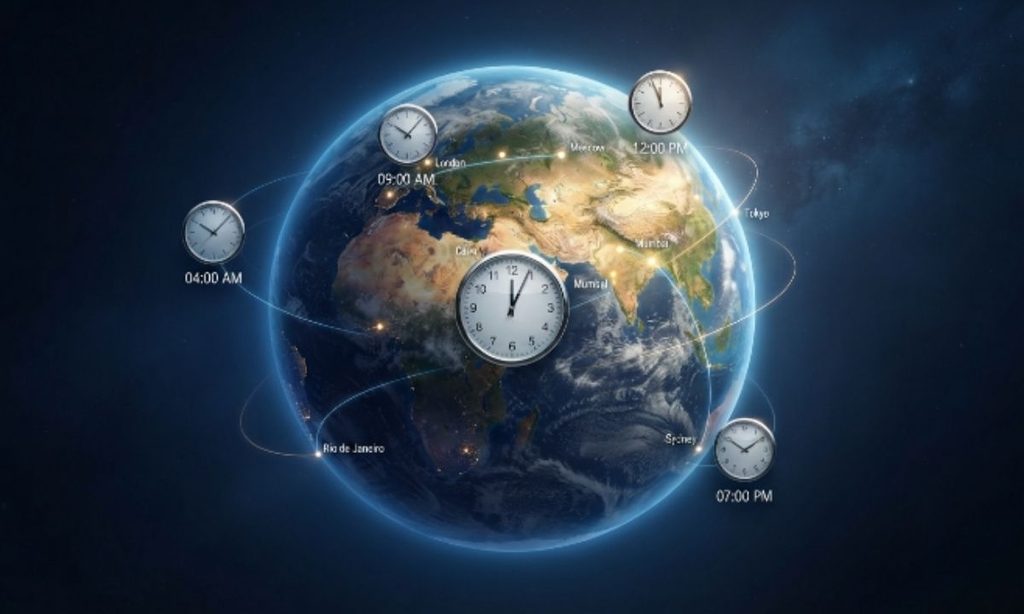
Noon happens at a different actual moment in every time zone around the world, since each zone reaches midday independently as the Earth rotates.
Practical tip: for any shared deadline or meeting, always pair the time with a zone label. “Noon” alone is only reliable for personal, local use.
Noon vs. Solar Noon
Clock noon and solar noon aren’t always the same thing, and it’s worth knowing the difference.
Civil noon (12:00 PM): The fixed clock time recognized everywhere within a time zone.
Solar noon: The actual moment the sun is at its highest point in the sky, which shifts slightly depending on your exact longitude, the time of year, and whether daylight saving time is in effect.
For everyday purposes — lunch breaks, meetings, deadlines — civil noon (12:00 PM on the clock) is what matters. Solar noon is more relevant to astronomy, navigation, and sun-position calculations.
Daylight Saving Time and Noon Calculations
If your region observes daylight saving time, be aware that clock changes can briefly complicate a countdown around the transition date itself.
Most devices adjust automatically when DST starts or ends.
Older systems or manually maintained calendars might not update right away.
If a countdown to noon looks off by an hour, check your device’s automatic time and time-zone settings first.
Outside of the one or two transition days each year, this isn’t something you need to think about — a plain subtraction works fine the rest of the time.
Common Uses for a Noon Countdown
People check “how long until 12:00 PM” for a handful of recurring, practical reasons:
Lunch breaks — a natural midday marker at work or school.
Meetings and calls — noon is a common scheduling slot.
Deadlines — many submissions and cutoffs land at midday.
School schedules — a frequent reference point for classes or dismissal.
Cooking and event timing — planning a meal or gathering around noon.
Whatever the reason, the goal is usually the same: an exact, no-guesswork answer.
Setting a Reminder for Noon
If you don’t want to keep checking a countdown manually, a few simple options can handle it for you:
Push notifications — many countdown tools can alert you at the exact moment noon hits, even if the browser tab is in the background.
Audible alarms — a sound cue the moment the countdown reaches zero.
Calendar reminders — set a recurring or one-time event for 12:00 PM.
Phone or desktop timers — a straightforward backup if you’d rather not rely on a website staying open.
These small tools remove the need to watch the clock at all.
Frequently Asked Questions
How many hours until 12 PM?
It depends on your current time — subtract your current hour from 12:00 to get the exact figure.
Is 12 PM noon or midnight?
12 PM is noon; 12 AM is midnight.
What is 12 PM in military time?
12 PM is written as 1200 in military time and 12:00 in 24-hour format.
What happens after 12 PM passes?
The countdown automatically resets and starts counting toward 12:00 PM the following day.
Does a noon countdown work across time zones?
It uses your local device time by default, so a shared “12 PM” plan needs an explicit time zone to stay accurate for everyone involved.
Conclusion
Understanding time to 12:00 PM is a matter of a simple concept: it is determined by the current time, and after noon is over the timer just points to noon tomorrow. Whether you use a live countdown or do the quick subtraction yourself, knowing the 24-hour conversion, the local time zone factor and the noon-versus-midnight difference means you’ll never be caught off guard by a midday deadline again.
I’m a passionate pet writer who loves sharing practical tips, trusted advice, and heartwarming stories about cats, dogs, and other beloved companions. Through PetCaffine.com, I help pet lovers better understand their furry friends with easy-to-read articles on pet care, nutrition, behavior, health, and everyday life.